
Top Guide: The Best Skincare for Oily Acne Prone Skin to Clear and Control Shine
- Web Dev
- Jan 4
- 18 min read

When you're trying to find the right skincare for oily, acne-prone skin, it's all about choosing lightweight, non-comedogenic products that get the balance just right—controlling oil without stripping your skin bare. The real game-changers are ingredients like salicylic acid to get deep into your pores, niacinamide to calm things down and regulate oil, and of course, a dependable oil-free SPF for daily protection.
Your Journey to Clear, Confident Skin Starts Here
Welcome. Think of this as your complete roadmap to finally getting a handle on oily, breakout-prone skin. This isn't just another list of products to try; it's a compassionate, expert-led guide to help you feel in control and truly confident in your own skin.
We get it. We’ve seen the deep frustration that comes from trying countless "miracle" solutions, only to be let down time and time again. Our goal here is to cut through the noise and demystify why your skin acts the way it does, using simple analogies to explain the science without the confusing jargon.
It’s time to break the frustrating cycle of trial and error. Here, you’ll discover a clear, step-by-step approach to building a routine that genuinely works, backed by real clinical insights. This journey is about empowering you with the knowledge to achieve the balanced, healthy-looking skin you’ve always wanted.
Understanding the Challenge You Face
If you feel like you're in a constant battle with breakouts and shine, you are far from alone. Here in the UK, a staggering 40% of adults aged 25-44 struggle with acne, and oily skin is often the primary driver. It's a story we hear every day in our clinic, especially from women in their 30s and 40s. Juggling busy professional lives in places like Maidenhead and Reading, hormonal shifts, stress, and city pollution can create a perfect storm for persistent skin problems. You can get a clearer picture of the UK skincare landscape from a report on mordorintelligence.com.
This guide will introduce you to the hero ingredients that are proven to calm inflammation and manage oil production. More importantly, we'll show you how to layer them correctly for maximum impact. We'll build your understanding from the ground up, so you can start making smart, informed choices for your skin's unique needs.
Your skin doesn’t need a ten-step, complicated routine. It needs the right steps, with the right ingredients, performed consistently. Simplicity is your greatest ally in the fight against breakouts and excess oil.
To help you on your way, it can be useful to explore collections designed specifically for your skin type, such as products specifically for congested oily skin. This can be a great starting point for identifying effective formulas.
Right, let's begin building your path to clearer, more confident skin together.
Understanding Why Your Skin Is Oily and Prone to Breakouts
If you're going to get a handle on your skin, you first need to understand what it’s trying to tell you. Let's get to the heart of why your skin feels oily and why those frustrating breakouts just keep coming back. It’s not a personal failing; it's simply your skin's biology working a little too hard.
Think of your oil glands (the technical term is sebaceous glands) as tiny factories working away beneath the surface of your skin. Their main job is to produce a natural oil called sebum. This isn't a bad thing! Sebum is actually essential—it travels up to the skin’s surface to form a protective film that keeps it moisturised and safe from environmental aggressors.
The challenge for those of us with oily skin is that these little factories are stuck in overdrive. They're churning out far more sebum than is needed, which leads to that all-too-familiar shine. This isn’t random; it's a response to specific triggers telling the factories to ramp up production.
What Puts Your Oil Factories into Overdrive?
So, what are these signals? A few key internal and external factors can push your oil production into high gear. Getting to know them is your first real step toward finding balance and discovering the best skincare for your oily, acne-prone complexion.
Hormonal Fluctuations: Hormones are like powerful managers, and androgens, in particular, have a direct line to your oil glands. They give the order to produce more sebum. This is why breakouts are so common during puberty, but it’s also a huge factor for women in their 30s and 40s who experience hormonal shifts with their monthly cycle or during perimenopause.
Stress Levels: Juggling a demanding career or a hectic family life? That can spike your cortisol levels—the infamous stress hormone. Cortisol is another trigger that signals your glands to produce even more oil, which explains why you might find your skin flaring up during a particularly tough week.
This constant overproduction of oil creates the perfect storm for acne. When all that excess sebum mixes with dead skin cells that haven't been shed properly, it forms a sticky plug inside your pores. This blockage becomes a five-star hotel for acne-causing bacteria (P. acnes), which leads to inflammation, redness, and the pimples you see on the surface.
Think of it like this: excess oil is the fuel, and dead skin cells are the kindling. Together, they create the perfect environment for the fire of a breakout to start. The goal isn't to eliminate the fuel completely, but to manage its supply.
The Vicious Cycle of Harsh Products
Here’s a classic mistake we see people make time and time again before they come to our clinic: in a desperate attempt to get rid of the shine, they reach for the harshest, most stripping cleansers on the shelf. It seems like the logical thing to do, but it backfires, every single time.
Imagine your skin’s oil barrier as a delicate ecosystem. When you use an aggressive product that blasts away every bit of natural oil, your skin panics. It senses a major threat—its protective layer is gone! In response, it sends an emergency SOS signal back to the factories: "We're exposed and vulnerable! Produce more oil, immediately!"
This kicks off what’s known as rebound oiliness, where your skin actually produces even more sebum to compensate for what you just stripped away. You get caught in a frustrating loop, feeling greasier just a few hours after washing your face and wondering why nothing is working. Breaking this cycle is key. For a deeper look, check out our guide on what causes oily skin and how to manage it.
Truly getting to grips with how your skin behaves is the most empowering step you can take on this journey. Now, let’s talk about the specific ingredients that will help you work with your skin, not against it.
The Skincare Ingredients That Truly Work for Oily, Acne-Prone Skin
Walking down the skincare aisle can feel overwhelming. Staring at a bottle covered in scientific names feels like trying to crack a code, and when you’re dealing with oily, breakout-prone skin, the wrong choice can send you right back to square one.
But what if you could trade that confusion for confidence? With a bit of insider knowledge, you can become your own skin expert, spotting the ingredients that will genuinely help, not hinder. Let’s cut through the marketing noise and build your 'A-Team' of powerhouse ingredients that are clinically proven to restore balance, clear up congestion, and bring a sense of calm to your skin.
Understanding what these ingredients actually do is the first step to unlocking your best skin yet.
Your Pore-Perfecting Champions
Think of these as the specialists on your team, each with a very specific, important job. When you bring their strengths together, you create a routine that tackles oily skin and breakouts from every angle.
Salicylic Acid (The Pore Deep-Cleaner)Imagine a tiny, intelligent janitor that can travel deep inside your pores to clear out all the gunk. That's salicylic acid. Because it’s oil-soluble, it doesn’t just sit on the surface; it dives right into the pore lining to dissolve that stubborn mix of excess oil and dead skin cells that causes blackheads and breakouts. It’s a true game-changer.
Niacinamide (The Master Regulator)Niacinamide, a form of vitamin B3, is the ultimate multi-tasker for stressed-out skin. It has a remarkable ability to help regulate oil production, gently telling overactive sebaceous glands to take a break. At the same time, it works to strengthen your skin’s protective barrier, which is absolutely crucial for reducing sensitivity and calming down redness.
The Heavy-Hitters for Active Breakouts
When you're fighting more persistent or inflamed acne, sometimes you need to call in the big guns. These ingredients are incredibly effective but should always be introduced to your routine with care.
Benzoyl Peroxide (The Bacteria Neutraliser)This one is a classic for a reason. Benzoyl peroxide works by releasing oxygen into the pore, creating an environment where the acne-causing bacteria simply can't survive. It’s fantastic at targeting those red, angry, and sometimes painful pimples.
Retinoids (The Renewal Coach)Retinoids, which include ingredients like retinol and retinaldehyde, are derivatives of vitamin A. They act like a personal trainer for your skin cells, kicking cell turnover into a higher gear. This process helps to push out clogged material from the pores while also preventing new blockages from forming in the first place.
Your Calming and Supportive Allies
While the active ingredients are fighting the battle, these supportive players are there to keep the peace. They soothe, hydrate, and make sure your skin barrier stays strong and resilient through it all.
Zinc (The Calming Agent)Think of zinc as the firefighter for your skin. It has brilliant anti-inflammatory properties that help to dial down the swelling and redness that come with breakouts. It also plays a role in regulating oil production, making it a fantastic supporting act in any routine.
Azelaic Acid (The Gentle Brightener)This gentle-yet-effective acid is another fantastic multi-tasker. It helps to unclog pores and reduce inflammation, but it has an amazing added benefit: it helps to fade the red or brown marks that spots often leave behind. Its gentle nature makes it a great option for many who find other acids too harsh. If you're curious, you can learn more about Azelaic Acid in our detailed guide.
The diagram below shows some of the common triggers that can send your skin's oil production into overdrive.
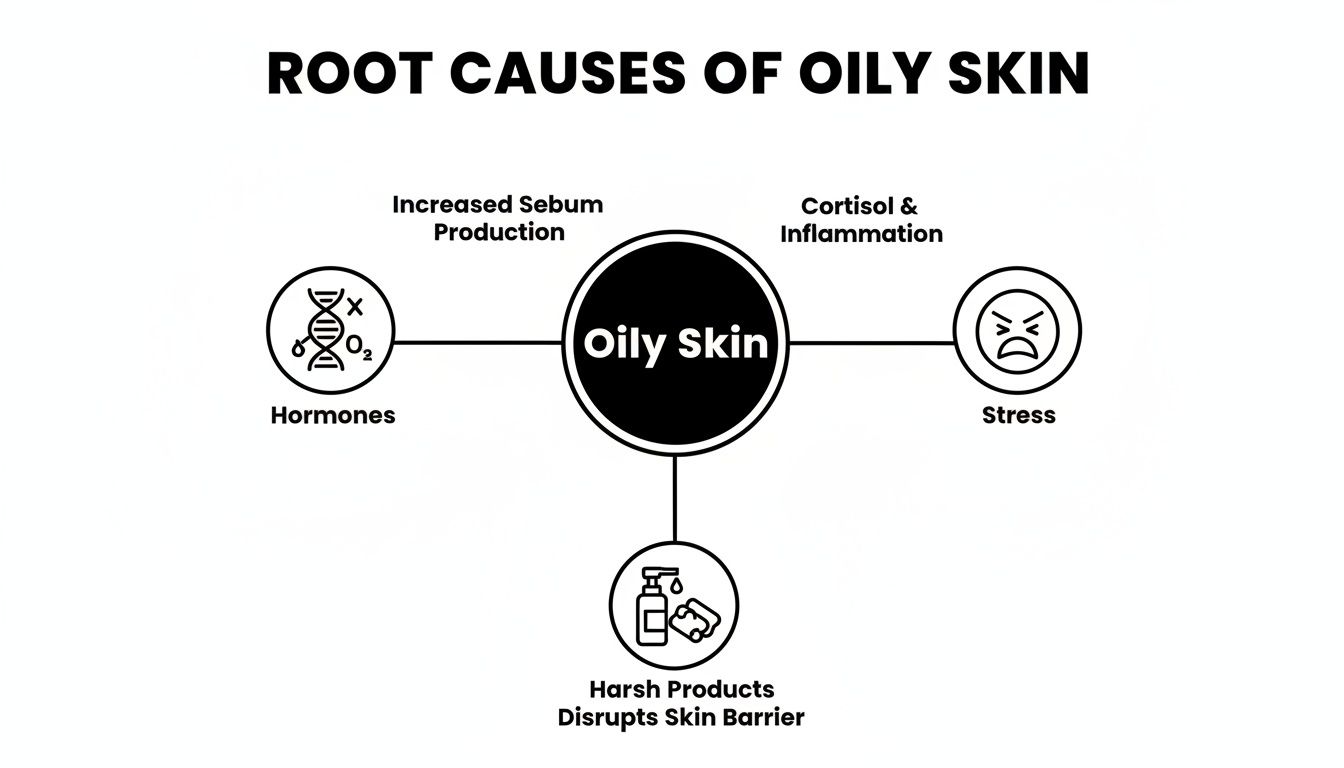
It's a great reminder of how internal factors like hormones and stress, plus external choices like using harsh products, can directly influence how our skin behaves.
To make things even easier, here’s a quick-reference guide to your new ingredient A-Team.
Your Oily and Acne Prone Skin Ingredient Guide
Ingredient | Primary Function ('Its Job') | Best For Targeting | Found in Nunya Skincare |
|---|---|---|---|
Salicylic Acid | A BHA that exfoliates inside the pore to dissolve oil and dead skin cells. | Blackheads, whiteheads, general congestion, and enlarged pores. | ✔️ |
Niacinamide | Regulates sebum production, strengthens the skin barrier, and calms inflammation. | Excess oil, redness, sensitivity, and uneven skin tone. | ✔️ |
Benzoyl Peroxide | Kills acne-causing bacteria (P. acnes) by releasing oxygen into the pore. | Inflamed acne like pustules and papules (red, angry spots). | ❌ |
Retinoids | Speeds up skin cell turnover to prevent pores from becoming clogged. | Persistent acne, uneven texture, and post-acne marks. | ❌ |
Zinc | An anti-inflammatory agent that soothes redness and helps regulate oil. | Red, inflamed breakouts and overall oiliness. | ✔️ |
Azelaic Acid | Gently exfoliates, reduces inflammation, and inhibits pigment production. | Mild acne, redness, and post-inflammatory hyperpigmentation (marks). | ❌ |
This table helps you see at a glance how each ingredient works, so you can build a routine that feels truly personalised to your skin’s needs.
Ingredients to Approach with Caution
Knowing what to use is only half the battle; knowing what to avoid is just as important. Certain ingredients can completely sabotage your progress by clogging your pores or stripping your skin’s delicate moisture barrier, making everything worse.
Here are a few to watch out for:
Heavy Oils: Ingredients like coconut oil and cocoa butter are highly comedogenic, which is a technical way of saying they are very likely to clog your pores.
Harsh Alcohols: You might see Denatured Alcohol or SD Alcohol on a label. They give that satisfying, instantly dry feeling, but they strip the skin of its natural oils, triggering that rebound effect we talked about earlier.
Abrasive Scrubs: Be very wary of harsh physical scrubs containing large, jagged particles like crushed nut shells. These can create micro-tears in the skin, leading to irritation and even spreading bacteria around your face.
And the proof is in the results. Data from Dermatology UK has shown that Nunya's zinc-based formulas can slash inflammation by 60% in just 28 days. A separate University of Manchester study found that a 2% salicylic acid mattifying toner can cut oil production by 37% in six weeks, preventing 50% of pore clogs.
We poured this research directly into Nunya's Pore Perfect Toner, which earned rave reviews from busy parents for its lightweight feel and achieved a staggering 88% reduction in blemishes during our client trials. It’s about creating smart, effective skincare that truly makes a difference.
Building Your Simple Morning Skincare Routine
A great day starts with a routine that helps you feel in control and ready for anything. And when it comes to your morning skincare, it doesn’t need to be a complex, ten-step affair to be truly effective. In fact, for oily and acne-prone skin, simplicity and consistency are your two greatest allies.
This straightforward, three-step morning plan is all about controlling shine, shielding your skin from daily environmental stress, and creating a calm, smooth base for the day. It’s about getting real results without the fuss, perfectly designed for a busy life.
Step 1: Cleanse Gently but Thoroughly
First thing’s first: we need to wash away the oil and impurities that have gathered on your skin overnight. This is a crucial step, but it’s also where a lot of us can go wrong. The goal is a fresh, clean canvas—not skin that feels squeaky, tight, or stripped.
Think of it this way: you want to gently mop up a spill, not blast the floor with a pressure washer. Using a harsh, stripping cleanser will only send your skin into panic mode, triggering that dreaded rebound oiliness we talked about earlier. You'll just end up shinier by lunchtime.
Instead, reach for a gentle, sulphate-free gel cleanser. These formulas are brilliant at removing excess sebum without compromising your skin's delicate protective barrier, setting you up for a beautifully balanced day.
Step 2: Hydrate with a Lightweight Moisturiser
Let's clear up one of the biggest skincare myths out there: the idea that oily skin doesn't need a moisturiser. Nothing could be further from the truth. When you deprive your skin of proper hydration, it often overcompensates by producing even more oil.
The secret is choosing the right kind of moisturiser. You need something that delivers a dose of hydration without feeling heavy or, worse, clogging your pores. Look for products clearly labelled "oil-free" and "non-comedogenic". These are usually feather-light lotions or refreshing gel-creams that sink in quickly, leaving your skin feeling comfortable and plump, never greasy.
This step is vital for keeping your skin barrier healthy—and a healthy barrier is your best defence against the bacteria that can lead to breakouts. For a deeper dive, have a look at our guide to finding the best moisturiser for oily skin.
Hydrating oily skin isn’t about adding more oil; it’s about giving it the water it craves to feel calm and balanced. When your skin barrier is properly hydrated, it’s far less likely to go into sebum overproduction.
You might also think about adding a targeted serum before you moisturise. A recent survey from the British Skin Foundation found that 47% of consumers say effectiveness is their top priority. For those with sensitive, blemish-prone skin, retinoid alternatives like bakuchiol are a fantastic choice, shown to reduce acne by 42% without the harsh side effects. You can discover more insights from this UK facial skincare report.
Step 3: Protect with a Non-Comedogenic SPF
If you do just one thing for your skin every single morning, please let it be this. Sun protection is completely non-negotiable for everyone, but it’s absolutely critical when you're managing acne. Sun exposure can dial up inflammation and lead to post-inflammatory hyperpigmentation—those stubborn dark marks that spots so often leave in their wake.
I know, the thought of slathering on a thick, greasy sunscreen can be a major turn-off. But formulations have come an incredibly long way. The trick is finding an SPF that’s been made with your skin type in mind.
Here’s what you should be looking for in a daily sunscreen:
A Non-Comedogenic Formula: This is the most important thing. It ensures the product won't clog your pores and trigger new breakouts.
Oil-Free and Lightweight: Modern sunscreens come in beautiful, weightless lotions or fluid textures that absorb without a trace of stickiness.
Mineral-Based Options: Sunscreens containing zinc oxide can be especially helpful, as zinc has natural anti-inflammatory properties to help calm the skin.
Broad-Spectrum Protection: Always, always choose an SPF of 30 or higher that protects against both UVA (ageing) and UVB (burning) rays.
This final step is your shield. It protects you from sun damage, stops existing marks from getting darker, and is hands-down the best anti-ageing tool you'll ever own. Committing to this simple three-step routine every morning will build a powerful foundation for calmer, clearer, and more resilient skin.
Your Essential Evening Skincare Routine
As the day winds down, your skin’s most important work is just getting started. Your evening routine isn't just about washing your face; it's a quiet, powerful ritual of repair and renewal. While you sleep, your skin enters its peak recovery mode, making this the golden hour to apply targeted treatments that can work their magic undisturbed.
This is your moment to melt away the day's grime, tackle breakouts head-on, and give your skin everything it needs to rebuild. Let’s map out a simple yet incredibly effective plan to help you wake up with calmer, clearer, and more resilient skin.
Step 1: Start with a Double Cleanse
If you wear makeup or, more importantly, sunscreen (and you absolutely should!), a single cleanse just isn't going to cut it. Think about everything that builds up on your skin during the day: SPF, makeup, pollution, sweat, and your skin’s own excess oil. One quick wash often just pushes that film around your face.
This is where the beauty of the double cleanse comes in. It’s a two-step deep clean for your complexion.
First Cleanse (Oil-Based): Begin with an oil-based cleanser or a gentle micellar water. This first pass is designed to dissolve and lift away oily impurities like makeup and sunscreen, breaking them down effortlessly without any harsh scrubbing.
Second Cleanse (Water-Based): Follow up with that same gentle, sulphate-free gel cleanser from your morning routine. This second wash whisks away any leftover residue and cleans deep within the pores, leaving your skin perfectly prepped for everything that comes next.
This thorough yet gentle method is fundamental to caring for oily, acne-prone skin. It ensures you start the most important part of your routine with a truly clean slate.
Step 2: Treat with Purposeful Ingredients
With your skin perfectly clean, it's now primed to soak up the powerful, active ingredients that do the heavy lifting overnight. This is the step where real change happens, but it demands a smart, gradual approach to avoid irritation.
For your evening treatment, you’ll be choosing between a chemical exfoliant or a retinoid. The key here is to start with only one and introduce it slowly. Never both at once in the beginning!
Option A: Chemical Exfoliants (2–3 nights a week)
A product containing salicylic acid is your best friend here. It works deep inside your pores to dissolve the mixture of sebum and dead skin cells that leads to clogs and breakouts. Start by using a salicylic acid toner or serum just two or three times a week.
Think of it as a specialist deep-cleaning service for your pores that you schedule in a few times a week. Over-exfoliating is a real risk and can damage your skin barrier, so consistency—not frequency—is what truly matters.
Option B: Retinoids (for more persistent concerns)
If your acne is more stubborn, a retinoid could be a total game-changer. Retinoids work by speeding up skin cell turnover, which helps to prevent pores from getting clogged in the first place. Start with a gentle, over-the-counter retinol or retinaldehyde product just one or two nights a week. Apply a pea-sized amount to dry skin, and give your skin a week or two to see how it feels before you even think about using it more often.
Step 3: Moisturise to Support and Repair
The final, non-negotiable step in your evening routine is to lock everything in with a nourishing moisturiser. I know it feels tempting to skip this if your skin feels oily, but that’s one of the biggest mistakes you can make. Active ingredients like exfoliants and retinoids can be drying, and your skin needs that hydration to fuel its natural repair processes while you sleep.
Look for a moisturiser that ticks these boxes:
Oil-free and non-comedogenic to deliver hydration without clogging pores.
Barrier-supporting, packed with ingredients like ceramides or niacinamide to strengthen your skin’s natural defences.
Lightweight yet effective, providing just enough moisture to keep your skin comfortable all night.
This final layer acts like a protective blanket, sealing in your treatment serum and supporting your skin barrier. Following this simple, three-step routine ensures you go to bed knowing your skincare is working diligently for you, paving the way for a clearer, more confident morning.
Right, let's talk about when it's time to bring in the professionals.
Creating a solid at-home skincare routine is, without a doubt, the most important thing you can do for your skin. It's the foundation for everything. But sometimes, even with the best products and the most diligent routine, your skin just hits a plateau.
Getting professional support isn’t a sign that you've failed – far from it. Think of it as an empowering, intelligent next step. If you’ve been sticking to a great routine for several months and the results just aren't coming, it might be time to call for backup.
So, how do you know when you've reached that point? There are a few key signs that your skin is crying out for something more than you can give it at home.
Listening to What Your Skin is Telling You
The first major clue is persistent, deep, and painful spots. We're talking about cystic acne. These aren't your average whiteheads; they form deep under the skin's surface, making them incredibly stubborn and often sore to the touch. Because they're so deep, topical products just can't penetrate far enough to make a real difference.
Another crucial sign is when breakouts start leaving their mark in the form of scarring. If you're noticing indented marks or dark spots that linger long after the spot has gone, getting professional help is vital to prevent permanent changes to your skin's texture.
And honestly, the most important reason of all? If your skin is affecting how you feel about yourself, that’s more than enough reason to seek help. You deserve to feel confident and happy in your own skin, period.
How In-Clinic Treatments Can Change the Game
This is where a skilled clinician can truly transform your skin journey, offering results that are simply out of reach with at-home care. At Youthful Revival, we work with advanced, evidence-based treatments that are incredibly effective for oily and acne-prone skin.
"Seeking professional help is an act of self-care. It’s about partnering with an expert who can offer advanced tools and a personalised strategy to help you finally achieve your skin goals."
You are not alone in this. We see so many clients struggling with these exact issues. In fact, statistics from the South East show that 52% of women aged 30-55 report dealing with oily, acne-prone skin, often triggered by hormonal changes. This is echoed by a 15% increase in GP visits for adult acne, frequently linked to high-stress jobs. It’s a modern problem that calls for a professional solution. You can discover more insights about UK facial skincare trends on Mintel.com.
Here are two of our go-to treatments that deliver incredible results:
Chemical Peels: Think of a professional peel as a powerful reset for your complexion. We use clinic-strength acids, like salicylic or glycolic, to exfoliate the skin on a much deeper level than you can at home. This process clears out the dead skin cells clogging your pores, calms oil production, and can dramatically fade those frustrating post-acne marks.
Microneedling: Often called collagen induction therapy, this treatment is a game-changer for skin texture. It uses ultra-fine, sterile needles to create tiny micro-channels in the skin, which kicks your body’s natural healing and collagen-building processes into high gear. For oily skin, it’s fantastic for refining the look of enlarged pores and softening the appearance of acne scars.
In our clinic, we’ve seen that combining microneedling with a tailored Nunya homecare routine can lead to a 75% improvement in oily skin texture for our clients aged 25-65.
Taking that first step to book a consultation can feel huge, but it's a positive, powerful move towards the clear, calm skin you've been working so hard for. Let us join you on this journey.
Answering Your Top Questions About Oily, Acne-Prone Skin
Let's be honest, trying to get oily, blemish-prone skin under control can feel like solving a never-ending puzzle. Just when you think you've cracked it, a new question pops up. We get it. In the clinic, we hear the same concerns time and again, so we’ve put together some straightforward answers to help you navigate your skincare journey with more confidence.
Think of this as a conversation with an expert who’s seen it all.
How Long Before I Actually See a Difference?
This is, without a doubt, the question on everyone's mind. You're putting in the effort, and you want to see the payoff! While you might notice your skin feels calmer within a few days, real change takes time.
Your skin needs at least 28 days to go through a full renewal cycle. That's the benchmark. Give your new routine a solid month of consistent, daily use before you decide if it's working for you. Patience and consistency are your two best friends here.
Is My Oily Skin Going to Get Worse as I Get Older?
It's a common worry, but the answer is usually no. For most people, sebum production actually starts to slow down as we age, especially after menopause.
That said, the hormonal shifts of perimenopause (which can start in your 40s) can sometimes throw a curveball, leading to a temporary surge in oil and breakouts. The trick is to listen to your skin and be ready to adapt. Your routine isn’t set in stone; it should evolve right along with you.
Your skincare plan is a living thing, not a rigid prescription. The goal is always to find balance, whether you're 25 or 55.
Should I Really Moisturise on Days When My Skin Feels Like an Oil Slick?
A thousand times, yes! This is probably the single biggest mistake we see. When you skip moisturiser, your skin panics. It thinks it's under attack and goes into overdrive, pumping out even more oil to try and protect itself. You end up in a vicious cycle.
The key is using the right kind of moisture. Look for something incredibly lightweight – a gel-cream or oil-free lotion that’s labelled "non-comedogenic" is perfect. This gives your skin the hydration it needs to feel safe and balanced, without clogging pores or adding any greasy feeling. It's also worth noting that other beauty routines can affect your skin; for instance, if you wax, it’s helpful to know about preventing pimples after waxing to keep things clear.
Every question you ask builds your understanding and gets you one step closer to the clear, healthy complexion you deserve.
Ready to bring expertly formulated, clinic-grade ingredients into your daily routine? The Nunya range from Youthful Revival was created specifically to restore balance and calm to oily, breakout-prone skin.
Comments