
The Best Retinol for Sensitive Skin A Gentle Path to Glowing Skin
- Web Dev
- Feb 10
- 15 min read

For anyone with a more delicate complexion, finding the best retinol for sensitive skin means looking for a smart formulation. If you're new to retinol, my practical advice is always to start with a lower concentration, somewhere in the 0.1% to 0.3% range. Look for a product packed with soothing ingredients like ceramides or niacinamide. This gentle, buffered approach is your secret to unlocking incredible anti-ageing results without the irritation, making your journey to youthful skin feel both inspiring and comfortable.
Your Gentle Start to Retinol for Sensitive Skin
So, you’re ready to begin your retinol journey, and you might be feeling a little nervous. If you’ve ever worried that glowing, rejuvenated skin was off-limits because of your skin's sensitivity, I’m here to show you a different path. We believe everyone deserves to feel incredible in their own skin, and it's absolutely possible to tap into the power of this amazing ingredient without the dreaded redness or peeling. The goal is to look refreshed and revitalised, not irritated.
Our entire philosophy is built on two simple words: low and slow.
Think of it like easing into a new fitness routine. You wouldn't walk into a gym for the first time and try to lift the heaviest weights, would you? Of course not. You'd start light to build strength and avoid injury. Retinol for sensitive skin requires that exact same respect and patience. Your skin needs time to adapt, and this gentle approach is your ticket to getting all the benefits without the backlash.
Why Less Is Truly More
Starting with a low concentration isn't just a suggestion—it's the cornerstone of success. It’s a principle so important that upcoming UK regulations are set to limit over-the-counter face products to 0.3% retinol from 2026. Why? Because higher strengths are often the culprit behind the sensitivity that nearly 44% of users report when using strong active ingredients.
Studies have shown time and again that a 0.3% concentration can deliver brilliant benefits, like boosted cell turnover, but with a dramatically lower risk of side effects. It’s all about nurturing your skin, not forcing it into submission. Gentle formulas are created with your skin barrier in mind, often pairing the retinol with calming ingredients that protect and hydrate. Adopting some of the gentle principles from Korean sensitive skin care can be a fantastic way to support your skin as you start.
The goal is not to endure irritation but to achieve beautiful, lasting results with comfort and confidence. Your skin’s health is the priority, and a gentle approach ensures you get the best of both worlds.
To help you get started on the right foot, here is a quick overview of the foundational steps we recommend for every client. Think of this as your personal cheat sheet.
Your Quick-Start Guide to Gentle Retinol
Key Principle | Why It Matters for Sensitive Skin | Your First Action |
|---|---|---|
Start Low | Minimises the initial shock to your skin, reducing the risk of redness, peeling, and discomfort. | Choose a product with 0.1% to 0.3% retinol or a gentle derivative like retinyl palmitate. Don't be tempted by higher numbers! |
Go Slow | Gives your skin cells time to adapt and build tolerance gradually, preventing an overwhelmed barrier. | Apply your retinol just once or twice a week to begin with, slowly increasing the frequency over a month or more. |
Buffer & Hydrate | Creates a protective layer that lessens the direct impact of retinol and locks in essential moisture. | Apply a simple, calming moisturiser before and after your retinol (the "sandwich" method). It's a game-changer. |
Support Your Routine | A healthy skincare ecosystem prevents other products from causing irritation that could be mistaken for retinol sensitivity. | Use a gentle, pH-balanced cleanser and a daily SPF 30+ to protect your skin. These are non-negotiable partners. |
Remember, a successful retinol routine is about more than just a single bottle. It’s about creating a supportive, nurturing ecosystem for your skin. That means pairing your new active with the right supporting cast. We're here to guide you along a safe path, proving that radiant skin is within reach for everyone.
So, How Does Retinol Actually Work Its Magic?
Let's break down the science behind retinol without making it feel like a chemistry lesson. It's actually quite beautiful. Think of retinol as a personal trainer for your skin cells. It doesn’t introduce a foreign substance; instead, it simply reminds your skin how to behave in its prime – more vibrant, more efficient, and healthier.
This powerhouse ingredient, a form of Vitamin A, essentially gets on the 'cell phone' to your skin cells and encourages them to speed up their natural rhythm. It's all about accelerating your skin’s renewal cycle to bring the fresh, glowing new cells to the surface much faster. To really get a feel for this, it helps to understand the process of cell turnover, which is at the very heart of what retinol does.
This supercharged renewal is the secret behind retinol's fame for softening fine lines, smoothing out texture, and giving you a more even-toned complexion. As a wonderful bonus, it also stimulates the production of collagen, the very protein that gives our skin its lovely firmness and bounce.
Why Sensitive Skin Craves a Softer Touch
If retinol is a workout for your skin, you can see how sensitive complexions might find it a bit like going from couch to marathon overnight. This cellular 'exercise' can temporarily disrupt your skin's protective barrier – that vital shield that locks in hydration and keeps irritants out. When this barrier is a little shaken, you might see the redness, dryness, or flakiness people often talk about when starting a retinoid.
This is precisely why a slow, gentle, and patient start is not just a suggestion, but a golden rule for you. The aim isn't to shock your skin into submission but to coach it, building its strength and resilience over time. It’s all about finding a formula that respects your skin’s delicate nature.
That initial adjustment period, often called 'retinisation,' is simply your skin getting used to its new fitness routine. It's a sign that wonderful things are happening beneath the surface, but it should always feel manageable, never painful.
This gentle philosophy is becoming the new standard. The UK's beauty scene, making up 8% of Europe's entire market, is leading the way. With new EU regulations on the horizon for 2026, capping over-the-counter face products at 0.3% retinol, the industry is already embracing the power of lower-strength, effective formulas. This shift is a huge validation that 'low and slow' is the smartest, safest, and most sustainable path for sensitive skin.
Getting to Know the Retinoid Family
'Retinoid' is the umbrella term for the whole family of Vitamin A derivatives. Once you know who's who, you'll be able to read an ingredients list with total confidence, knowing you're making the best choice for your skin. Here’s a quick rundown to help you feel like a pro.
Retinyl Esters (like Retinyl Palmitate): These are the gentlest relatives in the family. They need to go through several conversion steps in the skin before they become active, which makes them an incredibly safe starting point if your skin is highly reactive.
Retinol: This is the one you’ll see most often in shops. It’s the gold standard. It takes two steps to convert into the active form your skin uses, striking a perfect balance between being effective and well-tolerated, especially at lower strengths.
Retinaldehyde (Retinal): Consider this a step up from retinol. It’s just one conversion step away from being active, so it works a bit faster and is more potent than retinol, but it's still much gentler than prescription versions. It’s a great option when you’re ready to advance.
Retinoic Acid (Tretinoin): This is the pure, active form that all other retinoids are trying to become. It’s available only by prescription for a reason – it's incredibly powerful and comes with a higher risk of irritation.
For your journey, keeping your focus on retinyl esters and low-strength retinol is the most inspiring and effective place to start. By understanding these key players, you can choose a product that partners with your skin, not against it, setting you up for a truly beautiful, irritation-free experience.
How to Choose the Best Retinol for Your Sensitive Skin
Stepping into the world of retinol can feel a bit like learning a new language. You're suddenly faced with percentages, different formulas, and long ingredient lists. But this is where your power lies. Choosing the right product is the single most important step you can take towards reaching your skin goals with grace and confidence. Think of yourself as a skincare detective, searching for clues that a product will be a kind and effective partner for your skin.
The good news? The skincare industry is finally catching up. With new regulations on the horizon, brands are shifting their focus to create smarter, gentler formulas. This means there has never been a better time to find the best retinol for sensitive skin. You don't need the strongest product on the shelf; you need the smartest one.
Decoding the Concentration Numbers
When you see percentages like 0.1% or 0.3% on a bottle, it’s all too easy to assume that a bigger number means better, faster results. For sensitive skin, the opposite is nearly always true.
A lower concentration is your secret weapon for long-term success. It allows your skin to adapt beautifully without becoming overwhelmed, giving you all the incredible anti-ageing benefits—smoother texture, boosted collagen, and a more even tone—without the unwanted drama. This is about achieving a consistent, healthy glow, not chasing a quick fix that leaves your skin stressed.
Remember, retinol is a marathon, not a sprint. A practical tip: don't let anyone convince you that you need to "power through" a high-strength formula. Gentle consistency always wins.
Look for Advanced Formulation Secrets
Beyond the percentage, how the retinol is delivered to your skin is what truly separates a good product from a great one. The most sophisticated formulas are cleverly designed to minimise irritation while maximising those gorgeous results.
One of the biggest game-changers for sensitive complexions is encapsulated or time-release technology.
Think of it like this: instead of hitting your skin all at once, the retinol is delivered in tiny, protective bubbles. These bubbles dissolve slowly throughout the night, releasing the active ingredient gradually. This gentle, steady delivery is far less likely to trigger a reaction.
This clever approach ensures your skin gets the full benefits without the initial shock to its system. It’s proof that modern skincare can be both powerful and incredibly kind, making it a non-negotiable feature to look for.
Your Skin’s Supportive Allies
A truly brilliant retinol product for sensitive skin rarely works alone. The best formulas are buffered with a dream team of soothing, hydrating, and barrier-supporting ingredients. These are the "green flags" you should actively look for on any ingredients list.
They act like a comforting blanket for your skin, calming potential irritation before it even has a chance to start. When you spot these names, you know the product has been thoughtfully created with your skin's well-being front and centre.
Ceramides: These are the natural fats in your skin barrier. Adding them to a formula helps fortify your skin's defences, lock in precious moisture, and prevent dryness.
Niacinamide (Vitamin B3): A true multitasking hero. Niacinamide is fantastic at calming redness, strengthening the skin barrier, and refining skin texture.
Hyaluronic Acid: This famous humectant draws moisture into the skin like a magnet, providing a surge of hydration that beautifully counteracts any potential dryness from the retinol.
Bakuchiol: Often called a 'natural retinol,' this plant-based ingredient offers similar benefits with much less potential for irritation. It pairs wonderfully with retinol to enhance results gently.
These ingredients work in harmony with retinol, ensuring your journey is as comfortable as it is effective. They elevate a product from a simple 'active' into a complete, skin-nurturing treatment.
To help you feel more empowered on your next skincare shop, I've put together a simple checklist. It'll help you confidently tell the difference between products that will support your skin and those you should leave on the shelf.
Retinol Formulation Checklist for Sensitive Skin
Feature | Look For (Green Flags) | Avoid (Red Flags) |
|---|---|---|
Concentration | 0.1% - 0.3% retinol, or a gentle ester like retinyl palmitate. | High concentrations (0.5% or above) for your first product. |
Technology | Encapsulated, time-release, or buffered formulas for slow delivery. | Simple, high-strength formulas without any supportive technology. |
Ingredients | A cocktail of soothers like ceramides, niacinamide, and hyaluronic acid. | Formulas with high concentrations of fragrance, alcohol, or harsh exfoliants. |
Base | A creamy or hydrating serum base that feels nourishing on the skin. | Watery, alcohol-based serums that may be drying or stripping. |
By keeping these guidelines in mind, you can walk down the skincare aisle not with uncertainty, but with the empowering knowledge that you know exactly what your skin needs to truly thrive.
Your Step-by-Step Plan to Introduce Retinol Safely
Confidence comes from having a plan. I know that starting a new, powerful skincare ingredient can feel a little daunting, but with the right strategy, you can welcome even the best retinol for sensitive skin into your life with total peace and brilliant results. Remember, this isn't a race; it's a beautiful process of building your skin's strength and resilience over time.
Think of it like nurturing a delicate plant. You wouldn’t just stick it in harsh, direct sunlight all day from the get-go. Instead, you'd introduce it to the light gradually, letting it acclimatise and thrive. Your skin deserves that same thoughtful, gentle approach.
Your Essential Toolkit Companions
Before you even unscrew the cap on your new retinol product, let's make sure its supporting cast is in place. Retinol works best as part of a team, and these two partners are absolutely non-negotiable for keeping your skin happy, hydrated, and protected.
A Gentle, Sulphate-Free Cleanser: Your cleanser should leave your skin feeling calm and comfortable—never tight or stripped. Harsh cleansers can weaken your skin barrier, which just makes it more vulnerable to irritation from any active ingredient.
A High-SPF, Broad-Spectrum Sunscreen (SPF 30+): This is the golden rule of any retinol routine. Retinol can make your skin more sensitive to the sun, and failing to protect it can undo all your hard work. Make applying a generous amount of sunscreen every single morning an unbreakable habit.
With these staples ready in your bathroom cabinet, you’ve created the perfect safe and supportive environment for retinol to work its magic.
The Retinol Sandwich: Your Protective Buffer
The "retinol sandwich" is a complete game-changer, especially for anyone with a sensitive complexion. It’s a simple, elegant way to provide a comforting buffer for your skin, dramatically minimising the risk of dryness and irritation as it adjusts.
The method is exactly what it sounds like: you sandwich your retinol layer between two layers of moisturiser. This creates a gentle barrier that allows the retinol to get to work effectively, but with a much softer touch. It’s a genuine act of kindness for your skin that makes the whole process feel so much more comfortable.
Think of your first layer of moisturiser as a primer for your skin. It hydrates and calms the surface, getting it ready for the active ingredient. The second layer then seals everything in, locking in that precious moisture and supporting your skin barrier all night long.
And if you ever need a refresher on keeping that barrier strong, our guide on how to repair a damaged skin barrier offers practical tips that work beautifully alongside a retinol routine.
Your Week-by-Week Introduction Protocol
Patience is your superpower here. This slow, steady schedule is designed to let your skin build tolerance gradually, leading to sustainable, beautiful results without the drama. Listen to your skin—if you feel any significant discomfort, it's always okay to take an extra rest day.
Weeks 1 and 2: The Gentle Introduction
Cleanse: In the evening, start with clean, dry skin. Pat your face gently with a soft towel until it's completely dry.
Moisturise (Bottom Layer): Apply a thin layer of your favourite simple, hydrating moisturiser all over your face. Give it a few minutes to sink in properly.
Apply Retinol: Squeeze out a pea-sized amount of your retinol. Trust me, this is enough for your entire face. Dot it on your forehead, cheeks, and chin, then gently spread it evenly, avoiding the delicate skin right around your eyes and mouth.
Moisturise (Top Layer): Wait another few minutes, then apply a second layer of your moisturiser to seal everything in.
Frequency: Follow this routine just twice a week on non-consecutive nights (say, Monday and Thursday).
Weeks 3 and 4: Increasing the Tempo
If your skin is feeling happy and calm after the first two weeks, it's time to up the frequency just a little.
Continue using the retinol sandwich method.
Increase application to three nights a week (for example, Monday, Wednesday, and Friday).
Week 5 and Beyond: Finding Your Rhythm
From this point on, it’s all about tuning in and listening to what your skin is telling you.
If your skin continues to feel great, you can try increasing to every other night.
Eventually, many people with sensitive skin find their sweet spot is applying retinol 3-5 nights a week. Daily use isn't a requirement for incredible results.
This methodical plan takes the guesswork out of the equation and empowers you to partner with your skin. You are in complete control, guiding your complexion towards a stronger, smoother, and more radiant future at a pace that feels just right.
Navigating Setbacks and Soothing Your Skin
Even with the most careful, well-thought-out plan, sensitive skin can sometimes have a mind of its own. Let’s think of this as your supportive guide for those moments, designed to help you feel prepared and empowered, never panicked.
Experiencing a little dryness or redness doesn't mean you've failed! It simply means your skin is communicating with you, and learning to listen is the most beautiful part of this journey.
The real key is understanding the difference between the expected adjustment phase—often called ‘retinisation’—and genuine irritation. A little temporary dryness or minor flaking can be completely normal as your skin cells turn over and get stronger. However, significant redness, a stinging sensation, or persistent discomfort are your skin’s signals to pause and respond with kindness.
Your Skin Rescue Plan
If your skin feels genuinely unhappy, the first step is simple: take a break. Please don't try to push through the pain. Stop using your retinol and any other active ingredients like exfoliating acids immediately.
Your focus should now shift entirely to soothing and repairing. For the next few days, treat your skin like a cherished piece of silk.
Cleanse Gently: Use only a creamy, hydrating, sulphate-free cleanser that won’t strip your skin.
Hydrate Intensively: Be generous with a thick, calming moisturiser rich in ingredients like ceramides or niacinamide, applying it both morning and night.
Protect Always: Sunscreen is more important than ever. Be incredibly diligent with your daily SPF 30+ to shield your vulnerable skin from further stress.
Common Mistakes to Avoid
Sometimes, irritation doesn't come from the retinol itself but from how it's being used in our overall routine. An alarming trend in the UK shows that 25.7% of children aged 9-12 are using potent skincare actives, with nearly half experiencing irritation as a result. You can read the full report on youth skincare trends to understand more.
This highlights just how easily even adult skin can be overwhelmed if not treated with care. At Youthful Revival, we guide our clients to avoid these common pitfalls by sticking to low-dose retinols and gentle, supportive routines. Another classic mistake is applying retinol to damp skin, which can increase penetration and cause irritation. Always make sure your skin is completely dry before you apply it.
Your journey is unique. Responding to your skin with patience and gentle care isn't a setback—it's the most advanced technique of all. It ensures your path to glowing skin is both sustainable and joyful.
A fantastic way to buffer the application and minimise irritation is by using the 'retinol sandwich' technique, which this simple infographic illustrates perfectly.
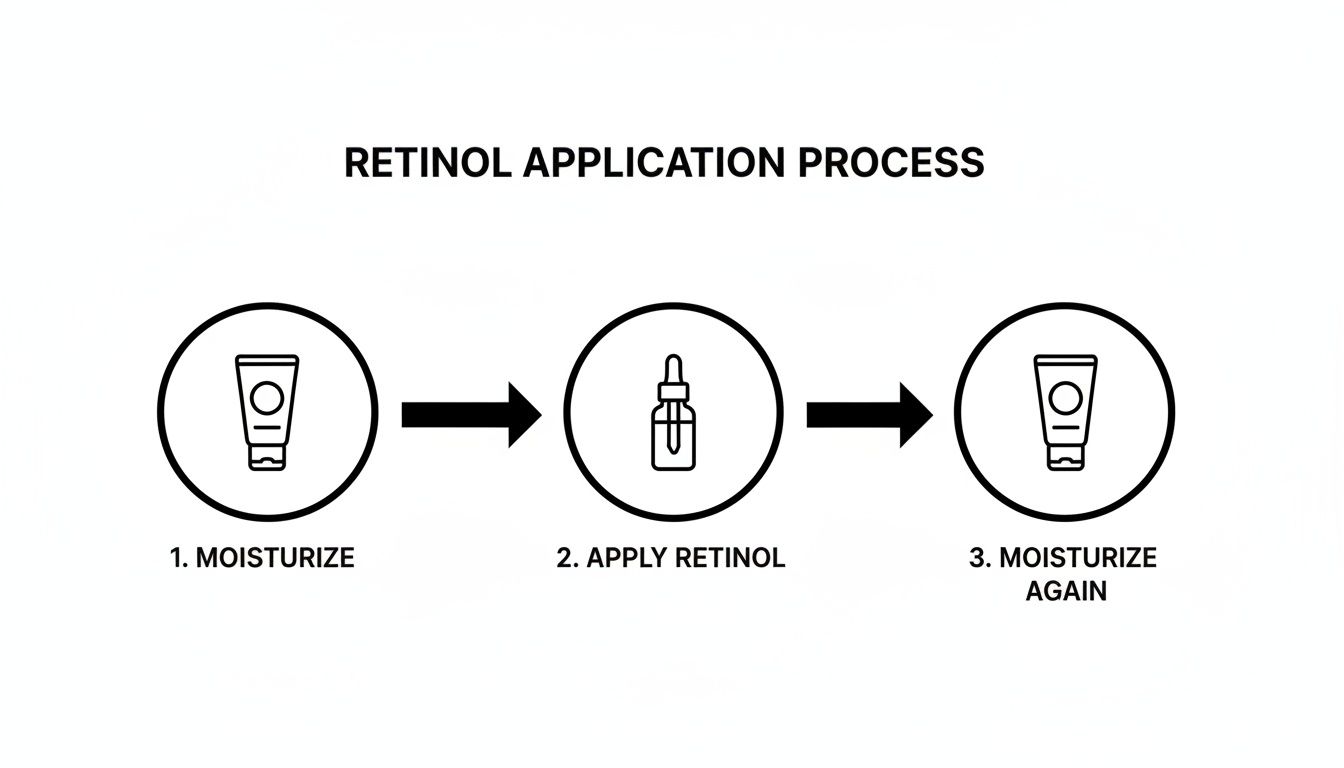
This clever method wraps your retinol in hydrating layers, ensuring it can get to work gently while your skin barrier stays protected, happy, and calm.
How to Gently Reintroduce Retinol
Once your skin feels completely calm and comfortable again for at least a week, you can think about reintroducing your retinol. This time, go even slower than before.
Start with just one application a week for two weeks, always using the sandwich method. If your skin remains happy, you can slowly and carefully build back up to your previous frequency.
It's also worth noting that sometimes you might be experiencing skin purging, which is different from irritation. You can learn more about skin purging in our detailed guide. This entire process is about building a trusting partnership with your skin, making sure it feels safe, supported, and ready to reveal its best self.
Your Retinol Questions, Answered
Starting your retinol journey is an exciting step, but it's completely normal to have a few questions as you go. Think of us as your skincare guides here at the Maidenhead clinic. We've heard it all, and we love demystifying the process for our clients. So, let’s dive into some of the most common queries we get about finding the best retinol for sensitive skin.
Can I Use Vitamin C and Retinol Together?
Yes, you definitely can! The trick is all in the timing. To give your sensitive skin the best experience with both of these incredible ingredients, it’s wise to keep them separate.
Think of it this way: use your Vitamin C serum in the morning. It’s a brilliant antioxidant that acts like a shield, protecting your skin from daily environmental damage like pollution. Then, let your gentle retinol take the night shift. It can get to work on renewal and repair while you rest, without any interference. This simple tweak lets you get the full power of both without overwhelming your skin.
How Long Until I See Results from a Gentle Retinol?
This is where a little patience really pays off. Because you’re taking that smart ‘low and slow’ approach, the results won't happen overnight—and that’s a good thing! We're aiming for happy, healthy skin, not a quick fix that causes irritation.
You’ll likely start to notice a lovely change in your skin’s texture and a brighter glow within 4 to 6 weeks. The bigger, more transformative results, like a visible softening of fine lines and a more even skin tone, tend to appear after about 3 to 6 months of consistent use. Remember, this is about sustainable, beautiful progress that puts your skin's health first.
Think of it like tending a garden. You can't rush a bloom, but with consistent care and patience, the results are always worth the wait. Every application is a step towards a healthier, more radiant complexion.
Are There Natural Alternatives to Retinol?
Absolutely! If you find your skin is just too reactive for retinol, or if you simply prefer a plant-based routine, Bakuchiol is a fantastic ingredient to get to know. It’s a plant-derived antioxidant that’s been clinically shown to offer very similar anti-ageing benefits to retinol.
It works wonderfully to improve the look of fine lines, pigmentation, and skin elasticity, but it comes with a much lower risk of causing irritation. It’s a brilliant, gentle option for anyone chasing that youthful glow without the worry.
Is It Normal for My Skin to Peel a Little Bit?
A little bit of mild flaking or a touch of dryness can be part of the initial "retinisation" phase, which is just your skin getting accustomed to the new ingredient. The key word here is mild.
This process should never be painful, excessive, or come with angry redness or a burning sensation. If you see some light flaking, double-check that you’re using the ‘retinol sandwich’ method and maybe add an extra rest day between applications. If the irritation doesn't settle down, that's your skin's signal to take a break from the product and have a chat with a professional.
At Youthful Revival, we believe your skincare journey should be one of confidence and joy. If you have more questions or would like personalised advice on finding the perfect routine for your sensitive skin, we're here to help. Explore our gentle, effective treatments and skincare solutions at https://www.youthfulrevival.com.
Comments