
Skincare routine for rosacea: Gentle steps to calm redness
- Web Dev
- Jan 5
- 17 min read

When you're living with rosacea, finding the right skincare routine is everything. It's all about being gentle and consistent, focusing on calming that fiery inflammation, rebuilding your skin's protective barrier, and steering clear of things that make it flare up. Think of it as a daily act of kindness to your skin. The absolute non-negotiables? A mild cleanser, a deeply soothing moisturiser, and a high-SPF mineral sunscreen, every single day.
Understanding and Embracing Your Rosacea Journey
Managing rosacea goes so much deeper than just dealing with redness. It’s about getting to know your skin in a way you never have before. Let's be honest, this journey can be incredibly frustrating at times, but I want you to know you are far from alone. This is your opportunity to reframe how you see your skin—not as flawed, but as unique and deserving of a special kind of care.
It's so easy to feel like you're the only one when a flare-up happens, but rosacea is surprisingly common. In the UK alone, there are over 60,000 diagnosed cases, and the condition has an incidence rate of 1.65 per 1,000 person-years. That means thousands of people, just like you, start this journey every year. It’s also worth noting that over 61% of those diagnosed are women. You can explore the UK-based rosacea research to see the full picture.
What Is Happening Beneath the Surface?
At its heart, rosacea is a chronic inflammatory condition. Imagine your skin as a delicate, finely-tuned ecosystem. With rosacea, that system is hyper-reactive, and it overreacts to certain triggers with a rush of inflammation. This is what causes the symptoms you see in the mirror:
Persistent Redness: This happens when the tiny blood vessels just under your skin's surface dilate and stay that way. It's often the most frustrating part because it feels so constant.
Bumps and Pustules: These small, red bumps, which can sometimes be filled with pus, are often mistaken for common acne. A key difference is that with rosacea, you typically won't see blackheads.
Visible Blood Vessels: Also known as telangiectasias, these are the fine red lines that appear when vessel walls lose their elasticity over time.
Skin Thickening: In some cases, the skin can become thick and bumpy, which is most common around the nose (a condition called rhinophyma).
Getting familiar with these signs is the first step toward feeling in control. It's not about self-diagnosis, but about learning to recognise the signals your skin is sending you. Every symptom is a clue, helping you and your clinician create a plan that truly works for you.
Building a Partnership with Your Skin
I find that a powerful mindset shift happens when you start to see your skin as a partner, not an enemy. Think of this guide as a supportive friend on that path, here to help you build confidence through knowledge. It’s about learning to listen, figuring out what your skin loves, and understanding what it needs you to avoid.
Your skin isn't "bad"—it's sensitive and communicative. A flare-up is simply your skin's way of telling you it's unhappy with something in its environment, whether internal or external. Learning to decode these messages is the key to lasting calm.
This journey is one of compassion and patience. With the right information and a gentle, thoughtful approach, you can create a daily ritual that not only soothes your skin but also nurtures your well-being. To continue building your knowledge, you might find these general skin health resources helpful as you move forward with confidence.
How to Identify Your Personal Rosacea Triggers

If there's one thing I tell every client, it's this: becoming your own skin detective is the most powerful step you can take on your rosacea journey. We know the common culprits, of course, but rosacea is intensely personal. What causes a flare for one person might be totally fine for another, which is why a one-size-fits-all approach just doesn't cut it.
This isn’t about restriction; it's about empowerment. It’s about learning to listen to the unique signals your body is sending so you can make confident, informed choices. By figuring out your specific triggers, you can shift from simply reacting to flare-ups to proactively keeping your skin calm and happy.
Your Guide to Keeping a Skin Diary
The best way to connect the dots is to keep a simple daily diary. You don't need a fancy leather-bound journal—the notes app on your phone will do just fine! The goal is to build a clear picture of your daily life and how your skin responds to it.
For at least a few weeks, try to jot down the following each day:
Food and drink: Be specific here. Don't just write "salad"—note that it was a "spinach salad with balsamic dressing and tomatoes." That morning coffee, a glass of red wine, or a spicy curry are all important details.
Weather and environment: Was it cold and windy on your walk to work? Did you spend all day in a stuffy, centrally-heated office? Sun exposure is a huge one, so make a note of any time spent outdoors.
Skincare and makeup: List every product that touches your face. This is crucial when you’re trying something new in your skincare routine for rosacea.
Stress levels: Give your stress a rating from 1 to 10. A high-pressure meeting or an emotional chat can absolutely be a trigger.
Physical activity: Did you have an intense spin class? Even a brisk walk that gets your body temperature up can be a piece of the puzzle.
Next to these notes, describe how your skin looks and feels. Did you notice any flushing, new bumps, or that familiar stinging sensation? It might take a little while, but soon enough, you'll start to see patterns emerge that you never would have suspected.
Real Stories and Common Patterns
So often, it’s the small, seemingly innocent daily habits that are the real culprits. I had one client who was convinced her new serum was the problem, but her skin diary told a different story. Her flare-ups were consistently happening on the days she had her morning latte extra hot. Just by letting it cool down for a few minutes, she saw a massive improvement.
Another client discovered it was the biting winter wind on her daily dog walk that caused her cheeks to flush bright red, not her moisturiser. By simply wrapping a soft scarf around the lower half of her face, she was able to protect her skin barrier and prevent the flare-up.
This detective work isn't about creating a long list of things you can never enjoy again. It's about gaining control through understanding. Knowing spicy food is a trigger doesn't mean you can never have a curry; it means you might opt for a milder one, or prep your skin with an extra-calming moisturiser before you go out.
This whole process transforms you from someone who just has to put up with their skin's behaviour into an active, knowledgeable partner in its health. It really is the foundation for building a gentle and truly effective skincare routine for rosacea.
Your Gentle Morning Skincare Routine for Rosacea
Think of your morning routine as building a gentle, protective shield for your skin. It’s not just about looking your best; it’s about preparing your face to calmly handle whatever the day throws at it. This daily ritual is your first line of defence against triggers, helping to keep redness and discomfort at bay before they even have a chance to start.
If you’re living with rosacea, you are far from alone. It's estimated that a staggering 415 million people across the globe are affected by this condition. It’s an incredibly common experience, even though it can often feel isolating. The key is finding a simple, consistent morning skincare routine for rosacea that puts you back in control.
Begin with a Gentle Cleanse
How you first touch your skin in the morning sets the tone for the rest of the day. The goal isn't to strip your skin bare, but to gently refresh it, washing away any impurities from overnight without upsetting its delicate balance.
One of the most powerful changes you can make is to ditch the hot water. Extreme temperatures are a classic trigger for flushing. Instead, make lukewarm water your skin’s best friend. When you reach for a cleanser, choose something creamy, milky, or non-foaming. Those satisfying lathers can often strip away natural oils, leaving your skin feeling tight, vulnerable, and ready to react. We have a whole guide to help you find the best cleanser for sensitive skin if you're feeling lost.
Pro Tip: How you apply your products is just as important as what you apply. Put the cleanser on your fingertips and massage it onto your face with light, gentle motions. Never, ever scrub. To rinse, gently splash your face with lukewarm water, then pat—don't rub—your skin dry with a soft, clean towel. This simple switch can make a world of difference.
Soothe and Treat Inflammation
With your skin clean and prepped, it's ready to absorb targeted treatments. This is your moment to introduce ingredients specifically chosen to calm inflammation and reinforce your skin’s natural barrier. It’s all about actively soothing your skin, not overwhelming it with a dozen different steps.
A true hero ingredient for so many of my clients with rosacea is niacinamide (a form of Vitamin B3). It’s a brilliant multi-tasker that gets to work by:
Calming inflammation: It helps to visibly reduce that persistent redness and blotchiness.
Strengthening the skin barrier: Niacinamide encourages your skin to produce more ceramides, the building blocks that keep its protective layer strong and resilient.
Boosting hydration: It helps your skin hold onto precious moisture, which is absolutely crucial for comfort and reducing sensitivity.
Apply a few drops of a niacinamide serum to slightly damp skin to help it sink in more effectively. And remember to keep using that gentle patting motion until it's fully absorbed. Less is often more; one well-chosen treatment serum is far better than layering multiple products that might just irritate your skin.
Protect with Mineral Sunscreen
If you do only one thing for your rosacea-prone skin each morning, please let it be this: apply sunscreen. Sun exposure is the single most common trigger for flare-ups, which makes daily, year-round protection completely non-negotiable. For skin as reactive as ours, mineral sunscreens are the gold standard.
Unlike their chemical counterparts, which absorb UV rays and convert them into heat (a recipe for flushing), mineral sunscreens work differently. They sit on the surface of your skin, using active ingredients like zinc oxide and titanium dioxide to form a physical shield that reflects UV rays away. It’s a much gentler approach.
Look for a broad-spectrum formula with an SPF of 30 or higher. Thankfully, modern mineral sunscreens are a world away from the thick white pastes of the past; many are now formulated to be lightweight and blend seamlessly. Apply it generously as the very last step in your routine, and you’ve given your skin the best possible defence for the day ahead.
To make things even easier, here's a quick summary of the routine we've just walked through.
Your Gentle Morning Rosacea Routine At a Glance
Step | Goal | What to Use | Key Ingredients |
|---|---|---|---|
Cleanse | Gently refresh skin without stripping natural oils. | Creamy, non-foaming cleanser. | Look for hydrating, soap-free formulas with ingredients like glycerin or ceramides. |
Treat | Calm redness and strengthen the skin's barrier. | A soothing, targeted serum. | Niacinamide is a superstar for reducing inflammation and improving skin resilience. |
Protect | Shield skin from UV rays, a major rosacea trigger. | Broad-spectrum mineral sunscreen. | Zinc Oxide and Titanium Dioxide are your best friends here. SPF 30 is the minimum. |
Following these simple, gentle steps every morning will help create a calm, resilient, and protected canvas, empowering you to face the day with confidence.
Your Restorative Evening Skincare Routine for Rosacea
As the day winds down, your skin’s work is just beginning. Night-time is a golden opportunity for repair and regeneration, a world away from the defensive posture your skin holds all day. While your morning routine is all about protection, your evening ritual is a quiet, restorative moment. It’s your chance to gently wash away the day's environmental stressors and give your skin the focused care it needs to heal, so you can wake up feeling calmer and more comfortable in your own skin.
My philosophy here is simple but powerful: 'less is often more.' You truly don't need an arsenal of products or a complicated regimen to see incredible results. A few thoughtfully chosen products, applied with care, can provide the deep nourishment and soothing your skin is crying out for.
The Essential Double Cleanse
If you've worn makeup or, more importantly, sunscreen (and I hope you have!), a single pass with a cleanser often isn't enough. Leftover product, oils, and daily grime can linger, leading to irritation and preventing those lovely restorative products from doing their job. This is where the gentle art of the double cleanse becomes your best friend.
It might sound fussy, but it's wonderfully simple. The goal is two-fold: first, you melt away that top layer of makeup and SPF, and second, you cleanse the skin itself.
First, Melt it Away (Oil or Balm): Start with a fragrance-free cleansing balm or oil, and be sure to apply it to dry skin. These formulas are brilliant at dissolving stubborn, oil-based products without any harsh rubbing. Gently massage it over your face, watching everything melt away. Then, add a splash of lukewarm water to turn it milky before rinsing it all off.
Second, Cleanse the Skin (Cream or Milk): Now, follow up with the same gentle, creamy cleanser you used in the morning. This second, quick cleanse ensures your skin is perfectly clean and prepped for the next steps, all without stripping its precious natural oils.
This two-step process gives you a truly thorough cleanse without compromising your delicate skin barrier. For many of my clients, it’s a total game-changer for preventing clogged pores and irritation.
Applying Targeted Treatments and Prescriptions
With your skin perfectly clean and still slightly damp, it's time for the potent stuff. This is the ideal moment to apply any prescription topicals your clinician has recommended, as they can get to work uninterrupted overnight. Whether you're using a specific cream for pustules or a gel to tackle redness, this is a crucial step.
If you aren't using a prescription, this is where a beautifully formulated hydrating or calming serum can work its magic. I always advise looking for formulas rich in ingredients that support the skin barrier, like ceramides or hyaluronic acid. These are the building blocks that help your skin hold onto vital moisture—a key factor in reducing sensitivity.
A Practical Tip from the Clinic: Always apply your products from the thinnest to the thickest consistency. This means your watery serum or prescription gel goes on before your richer night cream. It’s a simple rule that ensures each product can be properly absorbed without being blocked by a heavier formula.
Locking in Moisture for Overnight Repair
Your final, comforting step is to seal everything in with a nourishing moisturiser. Your evening moisturiser can, and probably should, be a little richer than your daytime one, as it doesn't have to perform under makeup or SPF. Think of it as a cosy blanket for your skin, locking in the treatments you've just applied and preventing that dreaded moisture loss while you sleep.
Look for moisturisers packed with calming ingredients that actively soothe inflammation. Some wonderful, hard-working options to look for on the label include:
Azelaic Acid: A true hero for rosacea-prone skin. It helps to reduce bumps, calm persistent redness, and gently improve skin tone over time.
Colloidal Oatmeal: Famous for its skin-soothing properties, it can bring immense relief from that frustrating itching and irritation.
Centella Asiatica (Cica): This botanical extract is renowned for its healing and anti-inflammatory benefits—perfect for calming down stressed-out skin.
For an extra boost of calm, especially during a flare-up, why not swap your moisturiser for an overnight mask once or twice a week? These are designed to provide a sustained release of soothing ingredients all night long. It’s a simple act of self-care that can make a visible difference by morning, leaving you with skin that feels deeply hydrated and noticeably less inflamed.
Decoding Ingredients for Rosacea-Prone Skin
Staring at a skincare label when you have reactive skin can be completely overwhelming. It's so easy to feel lost in a sea of scientific names, but learning to spot the heroes and villains for your skin is one of the most powerful steps you can take.
This isn’t about becoming a chemist overnight. It’s about learning your skin's unique language. Once you understand what it needs to feel calm and what makes it cry out for help, you can finally build a skincare routine for rosacea that brings genuine relief. It’s the key to turning an anxious daily task into a moment of true, restorative self-care.
The Calming Champions Your Skin Will Love
When you're scanning that ingredients list, you’re looking for things that soothe inflammation and rebuild your skin’s delicate defences. These are the ingredients that go beyond the surface, working to actively reduce redness and strengthen your skin barrier from the inside out.
Let's put the spotlight on some of the absolute superstars:
Azelaic Acid: If one ingredient was made for rosacea, this is it. It’s a true multi-tasker, brilliant at reducing the bumps and blemishes common with rosacea while also calming that persistent background redness. In fact, studies consistently show 70% to 80% of people see a real improvement after using it. For a deeper look, our guide explains the key skin benefits of Azelaic Acid in full detail.
Ceramides: Think of these as the cement that holds your skin cells (the bricks) together. A compromised skin barrier is a hallmark of rosacea, making it leaky and vulnerable. Topping up your ceramide levels helps patch up those gaps, locking precious moisture in and keeping irritants out.
Niacinamide: We’ve already mentioned this gem, but it deserves another round of applause. This form of Vitamin B3 is a master at soothing inflammation. Even better, it helps your skin produce more of its own ceramides, strengthening your barrier over the long run.
Colloidal Oatmeal: There's a reason this has been a trusted remedy for centuries. As a designated skin protectant, it forms a gentle, comforting film over the skin. It’s fantastic for providing immediate relief from the frustrating itchiness and irritation that so often come with a flare-up.
Red Flags: The Ingredients to Approach with Caution
Knowing what to welcome into your routine is only half the battle; knowing what to avoid is just as critical. Certain ingredients are notorious for triggering rosacea, either by stripping the skin's barrier, causing direct irritation, or increasing that dreaded heat and flushing.
Your skin is incredibly communicative. When it reacts to a product, it's not being difficult—it's sending you a clear signal that an ingredient is compromising its delicate balance. Learning to heed these warnings is crucial for long-term skin health.
Here are the common culprits to watch out for on any label:
Fragrance (Parfum): This is probably the number one trigger for sensitive skin. It doesn’t matter if it's synthetic or "natural"—both can be highly irritating. Always look for products that are explicitly "fragrance-free."
Alcohol (Denatured or SD Alcohol): Often found in toners, these alcohols give a quick-drying feel but are incredibly harsh on a delicate skin barrier. They can cause immediate dryness, tightness, and irritation.
Harsh Exfoliating Acids: Strong alpha-hydroxy acids (AHAs) like glycolic acid are often too aggressive for rosacea-prone skin, leading to increased redness and sensitivity.
Certain Essential Oils & Botanicals: Don't let the word "natural" fool you into thinking it's gentle. Ingredients like menthol, camphor, peppermint, eucalyptus, and witch hazel are well-known irritants that are best avoided.
To make things a little easier, here’s a quick-reference table to help you spot the good from the potentially problematic when you're next out shopping.
Rosacea Skincare Ingredients: Green Light vs Red Light
Green Light Ingredients (Calm & Soothe) | Red Light Ingredients (Approach with Caution or Avoid) |
|---|---|
Azelaic Acid | Fragrance / Parfum |
Niacinamide | Alcohol (SD or Denatured) |
Ceramides | Glycolic Acid |
Hyaluronic Acid | Witch Hazel |
Colloidal Oatmeal | Menthol / Camphor / Eucalyptus |
Centella Asiatica (Cica) | Sulphates (SLS/SLES) |
Green Tea Extract | Most Essential Oils |
Think of this table as your pocket guide. It's not about being perfect, but about making more informed choices that empower you to take control of your skin's health.
And to help you visualise how these choices fit into a practical evening routine, this simple guide breaks it all down.
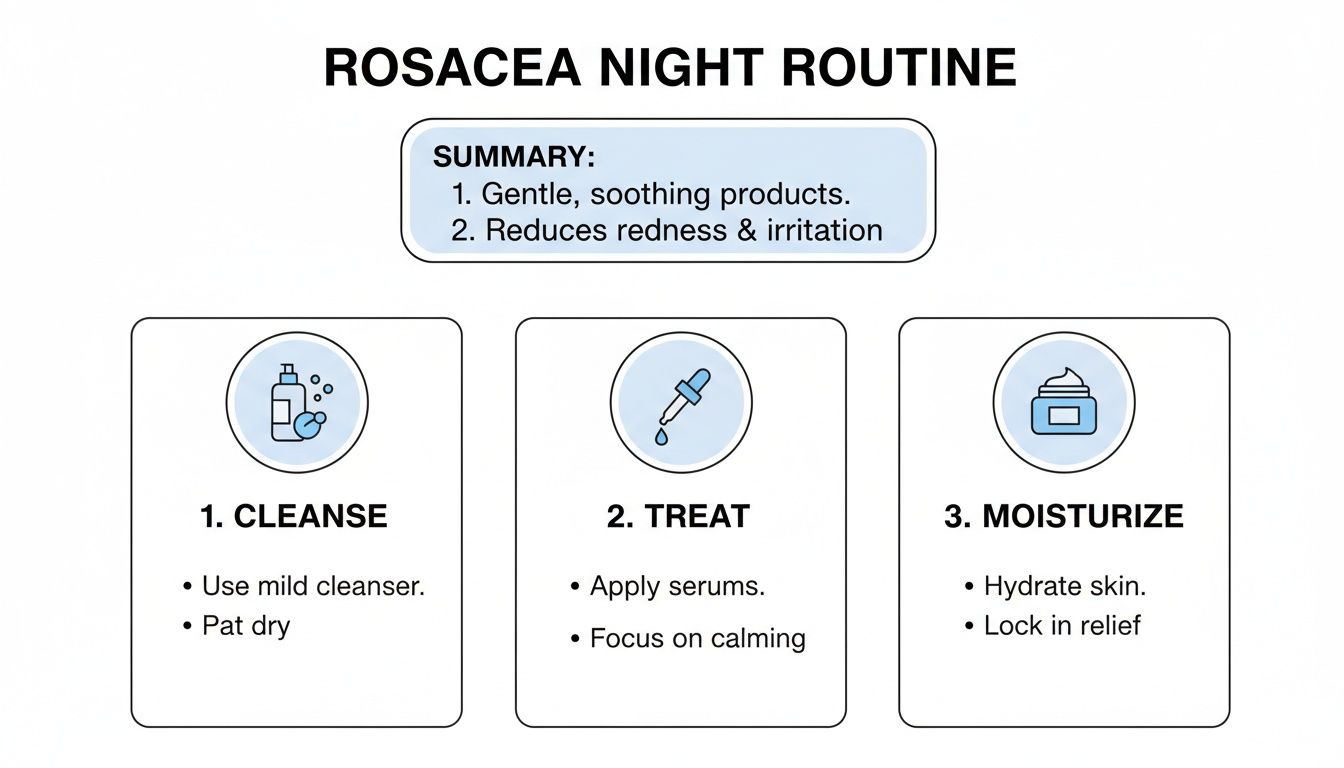
As you can see, a powerful, restorative routine is built on simple, consistent foundations: gently cleansing away the day, applying a targeted treatment, and locking in moisture to support your skin’s natural overnight repair process.
When a Professional Can Help Your Rosacea Journey
A dedicated home skincare routine for rosacea is your most powerful tool for managing your skin day-to-day. But what happens when you’ve done everything right and still feel like you’ve hit a wall? It's not a failure; it's a sign that it might be time to bring an expert onto your team.
Think of professional help not as a last resort, but as the next empowering step. It’s all about adding a new layer of expertise to the brilliant foundation you've already built at home.
Recognising the Signs to Seek Guidance
So, how do you know when it’s the right moment to book that consultation? Usually, your skin will tell you. You might be feeling completely fed up with flare-ups that just don’t seem to respond to your routine anymore. Or perhaps the constant redness is starting to knock your confidence.
Think of your clinician as a personal trainer for your skin. You do the daily work, and they provide the advanced techniques, expert guidance, and powerful tools to help you break through barriers and achieve results you couldn't reach alone.
It's also a well-known pattern that rosacea can become more prominent during certain life stages. Research shows it’s most prevalent among middle-aged individuals, especially Caucasian women in the UK. One study, for instance, found that 84.4% of rosacea patients were female with a mean age of 44 – the very time many of our clients first reach out for support. If you want to dive deeper, you can discover more about these demographic findings and see just how common this experience is.
How In-Clinic Treatments Complement Your Routine
Professional treatments are designed to work hand-in-hand with your home care. They target concerns at a level that topical products simply can't, accelerating your progress and offering profound, lasting improvements.
Here’s how they can elevate your results:
Targeting Persistent Redness: For that stubborn, diffuse redness and those visible broken capillaries (telangiectasias), professional options can be game-changing. To calm background redness and tackle visible veins, treatments like Lumecca IPL treatments are a fantastic option.
Managing Papules and Pustules: When bumps and blemishes are your main struggle, a clinician can offer prescription-strength topicals or other specialist treatments to reduce inflammation and clear the skin far more effectively than anything you can buy over the counter.
Building a Truly Personalised Plan: A seasoned expert can properly assess your unique skin presentation and history to create a plan that is perfectly suited to you. This takes all the guesswork out of the equation, saving you time, money, and the frustration of trying products that just aren't right for your skin.
Taking this step is an act of self-care. It's an investment in your well-being and a commitment to achieving the calm, comfortable skin you absolutely deserve. You’ve already done the hard work of getting to know your skin; now, let a professional help you take it to the next level.
Your Rosacea Questions Answered
When you’re trying to get to grips with rosacea, a lot of practical questions pop up. Feeling confident about what you’re doing day-to-day is a huge part of this, so let’s tackle some of the most common concerns we hear in the clinic.
Can I Ever Exfoliate If I Have Rosacea?
This is a tricky one, and it really comes down to being incredibly gentle. Harsh physical scrubs and aggressive chemical exfoliants? They’re definitely off the table, as they’re almost guaranteed to trigger a flare-up.
However, that doesn't mean all exfoliation is forbidden. For a super-mild approach, you could try using a soft, clean washcloth with your creamy cleanser. It gives just a whisper of manual exfoliation without aggravating your skin.
If you’re leaning towards a product, look for something with polyhydroxy acids (PHAs). Their molecules are larger than other acids, so they work on the very surface of the skin without causing irritation. The golden rules are to always patch-test first and stick to once a week at the absolute most.
How Long Until My New Routine Helps?
Patience truly is a virtue when it comes to calming rosacea. You'll likely feel a difference in hydration and comfort within the first couple of weeks, but seeing a real reduction in redness and papules takes time.
You need to give your new, gentle routine a proper chance to work. Commit to it for at least 6-12 weeks before you judge the results. This isn't about a quick fix; it's about building long-term resilience and calm for your skin.
Is It Okay to Wear Makeup with Rosacea?
Of course! The right makeup can be an amazing tool for boosting your confidence. The secret is simply choosing your products carefully. Many of our clients find that mineral-based powders are much better tolerated than liquid foundations, which often contain potential irritants like oils and fragrances.
Here's a little pro tip: a green-tinted primer can work wonders at cancelling out redness before you even think about foundation. And no matter what, always remember to remove it all gently but thoroughly at the end of the day. For more advice on this, take a look at our guide on how to reduce skin redness for calm, clear skin.
At YOUTHFUL REVIVAL, we're here to support you with expert advice and personalised treatments. If you're ready to take the next step towards calm, confident skin, we invite you to book a consultation with us today.
Comments