
Removal of dark circles under your eyes: A Practical Guide to Brighter Eyes
- Web Dev
- Dec 14, 2025
- 17 min read

Before we even think about treatments or products, the first step in saying goodbye to dark circles is a bit of detective work. Imagine you're trying to fix a problem without knowing its cause – it's just guesswork. Those shadows under your eyes aren't just about a lack of sleep; they're telling a story about your genetics, your lifestyle, and even the unique structure of your face. To get real, lasting results, you have to know what you're up against first.
Understanding What's Really Behind Your Dark Circles
If you’ve ever looked in the mirror and felt your dark circles make you look exhausted, you're in very good company. It’s one of the most common things people want to change, and it's almost always caused by a mix of factors.
It's a huge concern here in the UK. A recent survey highlighted that a staggering 25% of adults named under-eye circles as their main skin worry—even more so than wrinkles on their forehead. So if you're feeling self-conscious about them, please know you are not alone.
The True Culprits Behind Under-Eye Shadows
To find a solution that genuinely works for you, we need to pinpoint what's causing your specific type of dark circle. Think of it like a personalised prescription – once you know the cause, the right treatment becomes clear.
Vascular Issues and Thin Skin: The skin under our eyes is incredibly delicate—the thinnest on your entire body. This means that the tiny blood vessels just beneath the surface can easily show through, giving a blue or purple hue. When you're tired or dehydrated, your circulation slows down, allowing blood to pool and making those shadows look much darker. A practical tip? Gently press on the area. If the colour fades slightly and then returns, you're likely looking at a vascular issue.
Structural Shadows: Sometimes, the problem isn't colour at all, but contour. As we get older, we naturally lose a bit of the fat and collagen that keeps our faces looking plump. This can create a hollow under the eye, often called a 'tear trough'. It's this dip that casts a physical shadow, which looks like a dark circle. Try this: stand in a well-lit room and tilt your chin down while looking in a mirror. If the shadow becomes more prominent, it's a strong sign that structure is your primary issue.
Hyperpigmentation: For many people, particularly those with richer skin tones, the darkness is due to an overproduction of melanin, the pigment that gives skin its colour. This can be hereditary or brought on by things like sun exposure or even chronic rubbing of the eyes from allergies. This type of circle tends to look more brown or greyish.
To help you get a clearer picture, I've put together a quick reference table.
Identifying Your Primary Dark Circle Triggers
Cause | How It Creates Dark Circles | Who It Commonly Affects |
|---|---|---|
Vascular | Thin skin reveals underlying blue/purple blood vessels. Poor circulation makes it worse. | People with fair or thin skin, or those experiencing fatigue or dehydration. |
Structural | Loss of volume in the 'tear trough' area creates a physical shadow. | Often related to genetics or the natural ageing process. |
Pigmentation | An excess of melanin in the skin, resulting in brown or greyish discolouration. | Common in deeper skin tones, can be triggered by sun exposure or inflammation. |
Seeing your specific cause laid out like this can be the first step toward finding a real solution.
Your under-eye area tells a unique story. Understanding whether it speaks of genetics, volume loss, or pigmentation is the first, most empowering step toward reclaiming a refreshed and vibrant appearance.
Why Self-Diagnosis Can Be Tricky
Trying to figure this all out on your own can feel like a guessing game. You might spend a small fortune on a brightening eye cream meant for pigmentation, only to feel frustrated when it does nothing for the shadow caused by a structural hollow. No cream in the world can fill a volume deficit.
This is precisely where professional guidance makes all the difference. An expert can quickly and accurately assess whether your dark circles are down to:
Visible blood vessels (vascular)
Shadows from volume loss (structural)
Excess skin pigment (pigmentation)
Or, most commonly, a combination of these
Pinpointing your specific trigger is the key. It’s what separates wasting time and money from creating a targeted plan that delivers the visible, confidence-boosting results you're looking for. With that clarity, you can finally move forward with a strategy that's truly designed for you.
Everyday Habits That Brighten Your Under-Eye Area

While in-clinic treatments deliver fantastic results, the real journey to brighter, happier eyes starts right at home. Think of your daily habits as the foundation of your house; without a strong one, everything else you build on top is less effective. Lasting change comes from the small, consistent things you do every single day.
Forget about overnight miracles. We're aiming for a sustainable shift that empowers you to look and feel your absolute best. Let's dig deeper than the old "get more sleep" advice and explore practical tweaks that genuinely make a difference. These simple changes are your first line of defence in the effective removal of dark circles under your eyes.
Rethink Your Sleep Strategy
It's not just about how many hours you clock in, but the quality of that rest—and even the position you sleep in. One of the biggest culprits behind those bluish, vascular circles is poor circulation, and your sleeping posture can either help or hinder it dramatically.
Ever notice you wake up puffier on some days? Sleeping on your stomach or side can cause fluid to pool under your eyes. But a simple switch can work wonders. By sleeping on your back with your head slightly propped up on an extra pillow, you let gravity do the work, encouraging drainage and preventing that morning-after puffiness. It might feel strange at first, but stick with it for a week and you'll see the difference.
Honestly, one of the most powerful things you can do is to consistently learn how to improve sleep quality. A deeply restorative night's sleep is one of the best beauty tools you have at your disposal.
Hydrate and Nourish from the Inside Out
Your skin is an open book, reflecting exactly what's going on inside your body. Dehydration is a fast track to more prominent dark circles, as it makes the delicate under-eye skin look sunken and dull.
Make Hydration Easy: Don't wait until you're parched. I always tell my clients to keep a water bottle on their desk as a visual cue. Aim to refill it three times during the workday. If plain water feels like a chore, infuse it with cucumber or mint to make it more of a treat.
Eat for Brighter Eyes: Food is medicine for your skin. To fight inflammation and support strong, healthy blood vessels, try to work these into your diet: * Leafy Greens: Spinach and kale are loaded with Vitamin K, a star player in promoting healthy blood circulation. * Colourful Fruits: Think berries and citrus fruits. They're packed with Vitamin C, which is essential for building strong collagen. * Healthy Fats: Avocados and nuts are fantastic for keeping your skin supple and hydrated.
Every glass of water and every nutrient-dense meal is a direct investment in your skin's future. You are quite literally building healthier, more resilient skin from within.
Manage Digital Eye Strain
We live in a world of screens, and our eyes are paying the price. Staring at a device for hours on end forces the tiny blood vessels around your eyes into overdrive, causing them to enlarge and appear darker. It’s a modern-day cause of dark circles.
There’s a simple trick for this: the 20-20-20 rule. It's easy to remember and surprisingly effective. Every 20 minutes, look away from your screen at something at least 20 feet away for a full 20 seconds. Set a timer on your phone or computer to remind you. This gives your eye muscles a much-needed break, easing the strain and improving blood flow.
Practise Gentle Massage
You can give your circulation a little boost and help reduce fluid retention with a quick massage that takes less than a minute. It’s the perfect ritual to add to your morning or evening skincare routine.
Using your ring finger (it applies the least pressure), gently tap in a small circular motion around your entire eye socket. I recommend starting at the inner corner, moving up along the brow bone, and then sweeping down and around the under-eye area. This simple movement stimulates lymphatic drainage, helping to de-puff the area and soften the look of vascular circles. It also helps your eye cream absorb better, turning a routine step into a beautiful moment of self-care.
Mastering Your At-Home Under-Eye Skincare Routine
Navigating the world of skincare can feel like a maze, especially when you're determined to find a real solution for those stubborn dark circles. Let’s cut through the noise and get straight to what actually works. Honestly, building a consistent at-home routine is your most powerful tool. It’s how you can achieve visible, confidence-boosting improvements, turning skincare from a chore into a rewarding daily ritual.
This is where you take back control. By choosing the right ingredients and, just as importantly, applying them correctly, you're creating the perfect support system for the healthy lifestyle changes you’re making. The goal isn’t some complicated, 10-step process. It's about finding a simple, effective routine that works for you, day in and day out.
Your Morning Ritual For Bright, Protected Eyes
Think of your morning routine as having two essential jobs: first, to protect the incredibly delicate under-eye skin from daily aggressors like pollution and sun, and second, to give you an instant brightening and de-puffing boost. It’s all about starting your day feeling—and looking—refreshed.
A great morning routine doesn't need to be complicated at all. After a gentle cleanse, this is the perfect time for a targeted serum to wake up your skin.
Vitamin C: This antioxidant powerhouse is a non-negotiable for me. It helps fend off environmental damage that can worsen circles, and over time, it works wonders to brighten pigmentation for a much more even skin tone.
Hyaluronic Acid: Picture this as a huge drink of water for your skin. It pulls in moisture, plumping up those fine lines and making the whole under-eye area look smoother and more hydrated almost instantly.
After your serum sinks in, a dedicated eye cream is key. I always recommend looking for one with caffeine, which is brilliant at temporarily constricting blood vessels. This simple action helps dial down puffiness and reduces the appearance of those bluish, vascular circles, giving you a fresher look right away. If you're feeling a bit lost, we've put together a guide to the UK's best eye creams for puffiness and bags to help you choose.
But the single most crucial step in your morning routine? A broad-spectrum SPF of at least 30. Sun exposure is a primary driver of pigmentation and it absolutely decimates precious collagen, making dark circles significantly worse over time. Please, don't skip it.
For an extra boost, especially on those mornings when you wake up feeling particularly puffy, a simple tool can make a world of difference. Things like cooling eye masks are fantastic. You can even keep a teaspoon in the fridge and gently press the back of it against your under-eyes for a quick, soothing fix.
Your Evening Routine For Repair And Rejuvenation
Night-time is when the real magic happens. While you sleep, your skin kicks into its natural repair mode, and your evening routine should be all about giving it the active ingredients it needs to rebuild, strengthen, and correct the issues causing those circles. This is where you’ll see profound, long-term change.
After cleansing, it's time to bring in the heavy hitters.
Retinol: The Gold Standard for Skin Renewal
Retinol, a derivative of Vitamin A, is hands down one of the most effective ingredients you can use for the removal of dark circles under your eyes. It works by speeding up cell turnover and, most importantly, stimulating your skin to produce more collagen. With consistent use, this helps to thicken the delicate under-eye skin, making the blood vessels beneath far less visible.
If you’re new to retinol, start slowly. Try it just two or three nights a week to let your skin get used to it, and always choose a formula specifically made for the eye area to minimise any chance of irritation.
The Art of Applying Your Eye Cream
Believe it or not, how you apply your products is just as important as what's in them. The skin here is so fragile, so a gentle touch is non-negotiable.
Use Your Ring Finger: It naturally has the lightest touch, which prevents any unnecessary pulling or tugging.
A Little Goes a Long Way: You only need a single pea-sized amount for both eyes. Seriously. Using more won't speed up results, it will just waste product.
Tap, Don't Rub: Gently tap the product along your orbital bone (the bone you can feel around your eye socket). Work from the inner corner outwards and up towards your temple. Avoid getting too close to your lash line. This gentle tapping motion helps with absorption and stimulates circulation without stressing the skin.
The power of these targeted ingredients isn't just talk; it's backed by solid research. For example, we know that in the UK, hormonal fluctuations can make dark circles more pronounced in women. A clinical study on a specific eye defence cream found that after 60 days, a staggering 73% of subjects saw a reduction in red discolouration, with improvements that far outperformed a placebo.
By committing to a thoughtful morning and evening routine, you are making a direct investment in the health and appearance of your skin. It’s this consistency that will deliver the bright, refreshed, and well-rested eyes you deserve.
When It’s Time to Look Beyond Eye Creams
If you’ve been loyal to your eye cream and disciplined with your lifestyle changes but those stubborn under-eye shadows just won’t budge, I want you to know you’re not alone. And it’s definitely not a sign of failure. Skincare is absolutely your first line of defence, but sometimes the root cause of dark circles lies deeper than any cream can reach.
This is where professional treatments come in. Thinking about an in-clinic procedure isn’t about chasing an impossible ideal of perfection. It’s about making an empowered choice to find a solution that helps you look as vibrant and rested as you feel on the inside. When the basics have taken you as far as they can, it’s time to explore what else is possible.
Moving from Skincare to Solutions
So, how do you know you've hit that wall? It's usually when you realise your dark circles aren't just about fatigue or surface-level discolouration.
Hollowness and Volume Loss: If you see a distinct hollow or a "tear trough" groove under your eye, you're looking at a structural issue. This creates a physical shadow that no cream can fill. It needs a structural fix.
Deep-Seated Pigmentation: While some ingredients can help fade mild pigmentation, those deep, hereditary brown or greyish tones often require something more powerful to break up the excess melanin and truly even out the skin.
Thin Skin and Visible Veins: Sometimes, the problem is simply that the skin under our eyes is incredibly thin, making the tiny blue and purple blood vessels beneath more obvious. The solution here is to strengthen and thicken the skin, which helps to conceal what’s underneath.
This little guide can help you map out your primary concern and see which path might make the most sense for you.
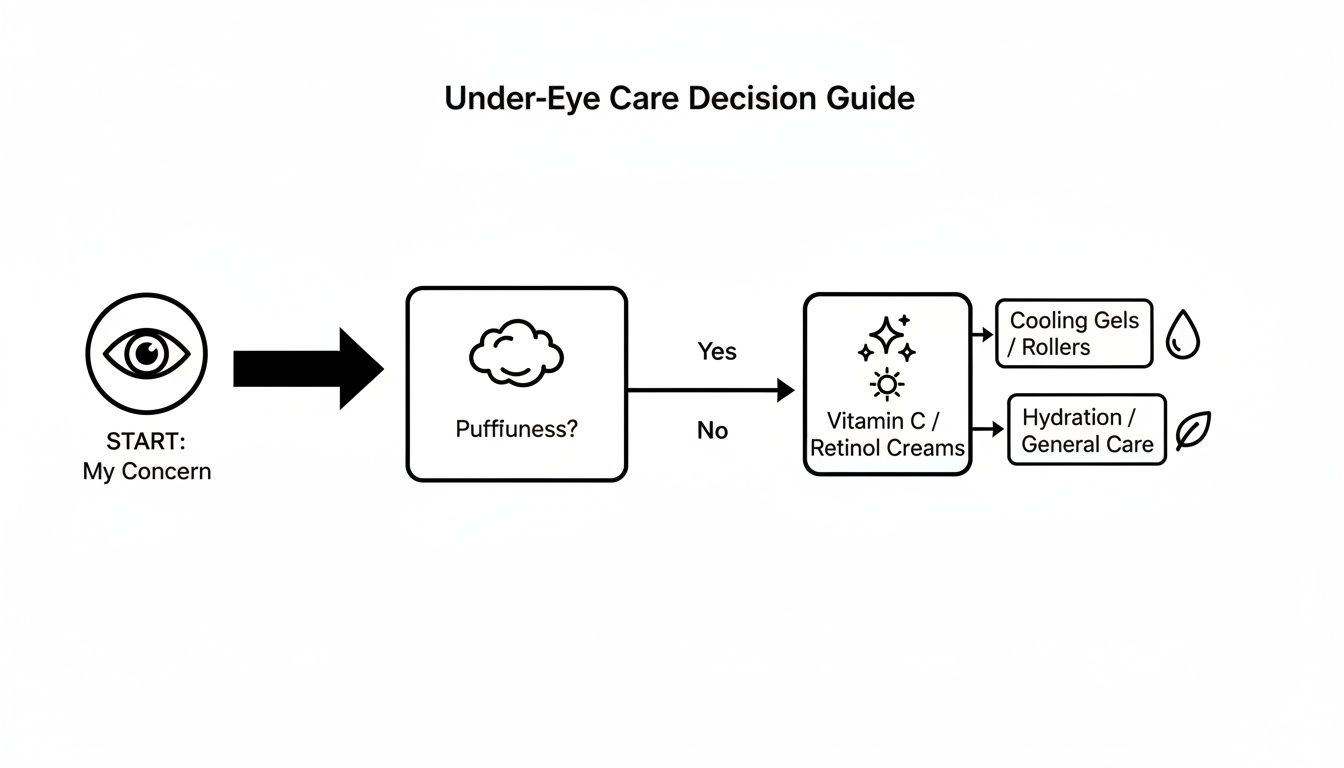
As you can see, puffiness and brightening sometimes need different, targeted approaches, which is why a proper consultation is so important.
Your Guide to Effective In-Clinic Treatments
Walking into an aesthetic clinic for the first time can feel a bit overwhelming with all the options available. Let’s break down some of the most trusted and effective treatments we see delivering incredible results right here in the UK.
A Practical Comparison of Professional Treatments
Here’s a side-by-side look at the leading in-clinic options to help you understand which treatment aligns with your goals and concerns.
Treatment | Best For | Average Cost (UK) | Downtime | Results Longevity |
|---|---|---|---|---|
Dermal Fillers | Sunken, hollow under-eyes (tear troughs) | £400 - £800 | Minimal (24-48h) | 9 - 18 months |
Laser Therapy | Brown or greyish pigmentation | £200 - £500 | 1 - 3 days | Long-term |
Platelet-Rich Plasma (PRP) | Thin, crepey skin & poor skin texture | £350 - £600 | 24 - 72h | 6 - 12 months |
This table gives you a starting point, but a personal consultation is always the best way to determine the perfect fit for your unique anatomy and concerns.
Dermal Fillers for Tear Troughs
For dark circles caused by that sunken, hollow look, dermal fillers are often the most transformative solution. A skilled practitioner uses a very fine needle to place a smooth, hyaluronic acid-based gel directly into the tear trough area. This instantly lifts the skin, restores lost volume, and quite literally makes the shadow disappear.
Who it’s for: Anyone with structural hollowness under the eyes.
What to expect: It’s surprisingly quick, usually around 30 minutes, with very little discomfort. The results are visible right away and can last anywhere from 9 to 18 months.
A practitioner's tip: The absolute key to a natural, beautiful result is the practitioner. You want someone with a deep understanding of facial anatomy. The goal isn't to look "filled," but to look refreshed, and an expert will use just the right amount to create a seamless, smooth transition.
Laser Therapy for Pigmentation
If your dark circles have a brownish or greyish hue, this is a clear sign of hyperpigmentation, and lasers can work wonders. The laser emits a specific wavelength of light that is absorbed by the excess melanin (pigment) in the skin. This shatters the pigment into tiny particles, which your body’s natural processes then clear away.
Who it’s for: People with pigmented dark circles, which can be more common in those with deeper skin tones.
What to expect: You'll typically need a series of sessions, spaced a few weeks apart, for the best outcome. You might have some mild redness for a day or so, but you can get right back to your routine.
A practitioner's tip: Sun protection is non-negotiable after laser treatments. A high-quality, broad-spectrum SPF is crucial to protect your investment and prevent the pigmentation from coming back. We dive much deeper into this in our guide to laser treatments for dark circles.
Moving from consistent at-home care to a professional treatment is a powerful act of self-investment. It’s the moment you decide to match your efforts with a solution designed for profound, visible change.
Platelet-Rich Plasma (PRP) Therapy
PRP is an incredible treatment that harnesses your body's own natural healing abilities to rejuvenate the under-eye area. It starts with a small blood sample, which is spun in a special machine to isolate the platelets—the part of your blood packed with powerful growth factors. This concentrated "liquid gold" is then carefully injected back into the skin under your eyes.
Who it’s for: Perfect for tackling thin, crepey skin and improving the overall quality, thickness, and texture of the under-eye area.
What to expect: PRP works by stimulating new collagen and elastin, so the results are gradual and incredibly natural-looking. You’ll start to see improvements over several weeks and months as your skin rebuilds itself from within.
A practitioner's tip: This is my favourite recommendation for anyone seeking a 100% natural approach. It’s not about adding volume like a filler; it’s about rebuilding healthier, stronger, and more resilient skin.
The interest in these procedures is soaring. In the UK, injectables and fillers are no longer a niche secret, with London clinics expecting 2025 to be a record-breaking year. Market analysis shows a staggering 50% growth in under-eye procedures, contributing to the 2.5 million aesthetic treatments performed across the country each year. This trend, heavily influenced by Millennials, highlights a shift towards seeking effective, long-term solutions for genetic shadows and signs of fatigue.
It’s Time to Create Your Own Brighter-Eye Blueprint
You’ve done the hard work of understanding why you have dark circles, from genetics to lifestyle, and you’ve seen the incredible range of solutions available. Now comes the exciting part: turning all that insight into your personal plan of action. This is where you take control.
Feeling empowered is the real first step. This isn't about chasing some impossible ideal of 'perfection' by next Tuesday. It's about making small, consistent, and smart choices that build towards real, noticeable change. Think of every step you take from here as an investment in yourself.
So, whether you decide to start with a new retinol eye cream tonight or book a chat with a professional to explore your options, the most important thing is to simply begin. You now have the knowledge to make a genuine difference and achieve that refreshed look you deserve.
Building a Strategy That Works for You
The best plans are never one-size-fits-all. A truly effective approach zeroes in on the root cause of your specific dark circles. Let’s pull all the threads together into a clear path forward.
For many, the journey starts at home with foundational lifestyle tweaks and a dedicated skincare routine. Give it a solid few months. If you’ve been consistent but still aren’t seeing the change you hoped for, that’s your cue to consider professional treatments.
If you see brown or greyish tones (Pigmentation): Your daily focus should be a Vitamin C serum in the morning and a gentle Retinol eye cream at night. Daily, non-negotiable sunscreen is your best friend here. If topical products don't quite cut it, Laser Therapy is a fantastic next step.
If you see shadows from hollowness: While great skincare can improve the skin's surface, it can't physically replace lost volume. When a sunken look is your main issue, the most direct route for the removal of dark circles under your eyes is almost always Dermal Fillers.
If you see blue or purple tones (Thin Skin): Start with a collagen-boosting routine packed with Retinol and Peptides. To really ramp up your skin’s thickness and quality from within, PRP Therapy is a brilliant, natural option to look into.
Here's a helpful way to think about it: your daily habits and skincare are what you do for your skin. Professional treatments are what you do with an expert to get results you simply can't achieve on your own.
Your Next Step Starts Now
Consistency is your superpower. Real, lasting results won’t come from a one-off treatment or a week of trying a new product. They come from the commitment you make to your skin's long-term health.
This journey is about so much more than fading a shadow. It’s about reclaiming your reflection, looking in the mirror, and seeing the vibrant, energetic person you feel like on the inside.
You have the tools. You have the knowledge. Your path to brighter eyes begins today.
Your Questions About Dark Circle Removal, Answered
Deciding to tackle your dark circles is a brilliant first step, but it’s natural to have a few questions swirling around. Before you jump into a new routine or consider a professional treatment, you want to know what you’re getting into. I get it completely.
To help you feel confident and clear about your next move, I've gathered the most common questions I hear from my clients. Let's clear up the confusion so you can focus on the path to brighter, more refreshed-looking eyes.
How Long Does It Really Take for Eye Creams to Work?
When it comes to skincare, patience truly is a virtue. While some ingredients, like hyaluronic acid, can give you an instant plumping effect that temporarily smooths things out, the real heavy-lifters need more time.
Ingredients like retinol and vitamin C, which work on pigmentation and boosting collagen, are playing the long game. You'll need to be consistent, applying your chosen cream every day for at least 8 to 12 weeks before you can expect to see a genuine change in colour and texture. A little tip I always share: take a 'before' photo in good daylight. It’s the best way to see the subtle but significant progress you're making.
Are Under-Eye Fillers Safe? And Are They Permanent?
In the hands of a skilled and qualified medical professional, under-eye fillers are an incredibly safe and effective option for tackling shadows caused by hollowness. They can make a remarkable difference, helping you look rested and revitalised.
But they aren't a permanent solution. Your body will naturally and safely break down the hyaluronic acid gel over time. This means those lovely, smooth results typically last anywhere from 9 to 18 months. To keep the look, you’ll need to schedule follow-up appointments.
Your number one priority must be choosing a reputable, experienced practitioner. This is what separates a beautiful, natural-looking result from a look that appears 'done'. Your safety and satisfaction depend on it.
Can I Get Rid of Genetic Dark Circles for Good?
This is a question I hear a lot, and it deserves a straight-up, honest answer. If your dark circles are part of your genetic makeup—perhaps due to naturally thinner skin or the structure of your eye sockets—then completely erasing them is unlikely.
However, and this is a big however, you can absolutely make them far less noticeable. For inherited dark circles, the best strategy is usually a combination approach. A great retinol-based eye cream can help thicken the skin over time, making the blood vessels underneath less visible. At the same time, a professional treatment like dermal fillers can beautifully mask the hollows that create those stubborn shadows. While you can't change your genes, modern approaches to the removal of dark circles under your eyes can make a huge difference in how you see yourself in the mirror.
When Should I Chat with My Doctor About Dark Circles?
For most of us, dark circles are a cosmetic frustration rather than a medical concern. That said, there are a few situations where it’s a good idea to book an appointment with your GP.
You should definitely seek a medical opinion if your dark circles:
Show up very suddenly or get worse quickly.
Only appear under one eye.
Come with other symptoms like swelling, itching, or unexplained fatigue.
While it's rare, dark circles can sometimes be a sign of an underlying issue like allergies, anaemia, or a thyroid condition. A quick chat with your doctor can rule out any health concerns and give you the peace of mind to focus on finding the right cosmetic solution.
Ready to explore your options with an expert? At YOUTHFUL REVIVAL, we specialise in creating bespoke treatment plans for natural, refreshing results. Book your consultation with us today and let's start the journey to brighter, more confident eyes together.
Comments