
How to Reduce Fine Lines for Smoother Skin
- Colleen Jenkins
- Aug 25, 2025
- 14 min read

When it comes to visibly reducing fine lines, consistency is everything. The most effective strategy isn't about a dozen different products you'll never use; it's about a dedicated daily routine that protects your skin by day and repairs it by night. This powerful one-two punch relies on powerhouse ingredients like Vitamin C, retinoids, and—of course—sunscreen.
Your Foundational Skincare Routine to Soften Fine Lines
Building a daily defence against fine lines doesn't require a complicated, ten-step ritual that you'll abandon after a week. It’s all about being consistent and using a handful of active ingredients that genuinely get the job done.
Think of your skincare as a simple but powerful system: you're protecting your skin from the world during the day, and then giving it the tools it needs to repair itself while you sleep. It’s a simple promise you make to your skin each day.
This commitment to effective skincare is clearly a growing priority. The UK anti-ageing market was valued at an estimated USD 3.57 billion in 2024, and that figure is expected to climb. This surge is fuelled by a greater understanding of preventative care and the real, science-backed power of certain ingredients.
A Simple Morning vs Evening Routine for Fine Lines
Here’s a clear, at-a-glance guide to structuring your daily skincare for the best results against fine lines. Think of this as your cheat sheet to getting it right every day.
Skincare Step | Morning (AM) Focus: Protection | Evening (PM) Focus: Repair |
|---|---|---|
1. Cleanse | Gentle cleanser to remove impurities without stripping the skin. | Thorough cleanse to remove makeup, SPF, and daily grime. |
2. Treat | Vitamin C Serum: A potent antioxidant to fight free radical damage. | Retinoid: To boost cell turnover and stimulate collagen production. |
3. Hydrate | A lightweight moisturiser to lock in hydration and prep for SPF. | A richer, more nourishing moisturiser to support the skin barrier. |
4. Protect | Broad-Spectrum SPF 30+: The non-negotiable final step to shield skin. | - |
This table shows how each routine has a distinct purpose. The morning is all about defence, while the evening is focused on active repair and regeneration.
Morning Protection: Your Personal Bodyguard
Your morning routine has one critical job: to shield your skin from the environmental stressors that accelerate fine lines, namely UV rays and pollution. The undisputed hero for this task is a good Vitamin C serum.
This powerful antioxidant acts like a personal bodyguard for your skin cells. It works by neutralising damage from free radicals before they get a chance to break down your precious collagen. After cleansing, just apply a few drops of a stable Vitamin C serum, follow it up with your moisturiser, and finish with a broad-spectrum sunscreen of at least SPF 30. That last step is absolutely non-negotiable, even on those quintessentially cloudy British days.
A simple, consistent routine is far more effective than an elaborate, inconsistent one. Your skin thrives on predictability, so focus on mastering the basics—cleanse, treat, protect—before adding more complexity. This is how you get real results.
Evening Repair: The Gold Standard Treatment
Night-time is when your skin naturally switches into repair mode. This makes it the perfect opportunity to introduce the single most proven ingredient for reducing fine lines: retinoids.
Retinoids, which are derivatives of Vitamin A, are true workhorses. They speed up cell turnover and stimulate collagen production from deep within the skin. This process helps smooth out the lines you already have and prevent new ones from forming. If you’re new to retinoids, it's wise to start slow with a low-strength formula (like 0.2% retinol) just two or three nights a week to let your skin adjust and avoid irritation. Your skin needs time to get used to it, so don't rush the process.
The image below gives a great visual of the core daily steps for building your defence.
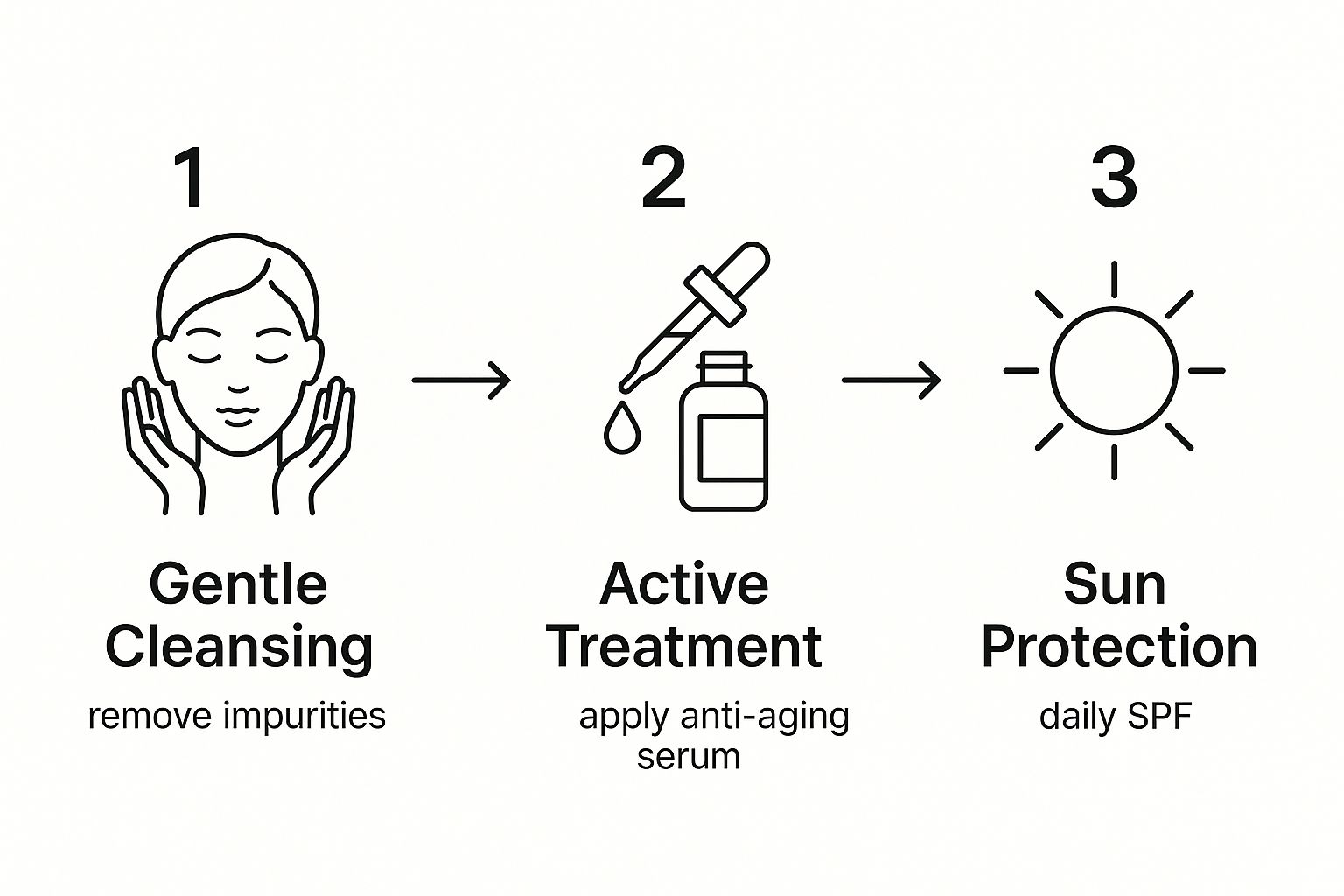
This simple flow—cleanse, treat, protect—is the cornerstone of any effective anti-ageing strategy. It ensures your skin is prepped to receive those active ingredients and is properly shielded from daily damage.
Always follow your nightly retinoid with a deeply hydrating moisturiser. This helps counteract any potential dryness and supports your skin's barrier—a step that's especially crucial for the delicate skin around the eyes. You can find more targeted advice in our complete guide to reducing wrinkles under eyes.
Stepping Up Your Game: Professional Injectable Treatments

When your daily skincare routine has done all it can, sometimes you need to bring in the professionals for more targeted, dramatic results. For many people looking to soften lines that are a little more stubborn, injectables are the natural next step.
And it’s a step that more and more of us are taking. The UK aesthetics industry is booming, and non-invasive procedures are now completely mainstream. Back in 2024, clinics performed an estimated 892,000 aesthetic treatments, and with millions more considering it, the demand for effective solutions isn't slowing down. This growth is hugely down to injectables, which offer a direct route to smoothing out those frustrating wrinkles.
This isn’t about chasing a frozen, unnatural look. It’s about gently softening the lines that you find bothersome, helping you look refreshed and feel more confident. The two main players in this field are neurotoxins and dermal fillers, and they each do very different jobs.
Neurotoxins for Those Expression Lines
Neurotoxins, with Botox being the household name, are fantastic for tackling dynamic wrinkles. These are the lines that pop up when you move your face—the crow’s feet when you smile, or those frown lines between your brows when you’re concentrating.
The magic lies in how they work: they temporarily relax the tiny muscles responsible for these repetitive movements. When the muscle can't contract as forcefully, the skin on top gets a welcome break and smooths itself out. It’s as simple as that.
A skilled practitioner aims for subtlety. You should still look like you, with all your natural expressions intact—just a smoother, more rested version. A light touch is everything; it’s about softening lines, not erasing your personality.
The treatment itself is incredibly quick, usually over in about 15-20 minutes. The full effect then develops over the next week or two. You can typically expect the results to last for about three to four months before you might consider a top-up.
Dermal Fillers for Restoring Volume and Deeper Lines
Dermal fillers are a different beast altogether. Instead of relaxing muscles, their purpose is to add back lost volume and plump the skin from underneath. Most modern fillers are based on hyaluronic acid, a sugar molecule your body already produces.
They are the go-to solution for static lines—the ones you can see even when your face is completely still. Fillers work wonders on areas like:
Nasolabial folds: The creases running from your nose to the corners of your mouth.
Marionette lines: The lines that go downwards from the corners of your mouth.
Fine lines around the lips: Sometimes called 'smoker's lines,' even in people who have never smoked.
By strategically placing filler beneath these lines, a practitioner can physically lift and smooth the skin for a much softer look. The best part? The results are instant and can last anywhere from six to eighteen months, depending on the specific filler and your body's metabolism.
While both treatments are brilliant, it’s crucial to understand what they’re designed for. If you’re not sure which path is right for you, have a look at our guide comparing Botox vs. Dermal Fillers to get a clearer picture.
Improving Skin Texture with In-Clinic Resurfacing
So, you’ve got your daily skincare routine dialled in, but you’re not quite ready to dip your toes into the world of injectables. If you're looking for that next level of improvement, skin resurfacing treatments are a brilliant middle ground.
These procedures are specifically designed to work on the surface layers of your skin to improve its overall texture, soften those pesky fine lines, and bring back a healthy, youthful glow. They're a fantastic choice if you feel your complexion has lost its lustre or just isn't as smooth as it once was.
In my experience, the two most popular and effective options you'll find in clinics today are chemical peels and microneedling.
Chemical Peels for a Brighter Complexion
The phrase "chemical peel" can sound a bit intimidating, I know. But it covers a huge spectrum of treatments, from incredibly gentle to much more intensive. The basic principle is the same: a specially formulated solution is applied to the skin, which meticulously exfoliates the top layers. This process signals your body to bring fresh, new skin cells to the surface.
This controlled removal of old, dull skin is a game-changer for minimising fine lines and boosting overall clarity.
Light 'Lunchtime' Peels: These often use mild acids like glycolic or lactic acid. The beauty of these is the minimal downtime—you might have a little pinkness, but mostly you’ll just leave with a radiant glow. They're perfect for a quick refresh before a big event.
Medium-Depth Peels: Using stronger solutions like TCA, these peels penetrate more deeply into the skin. They're better suited for tackling more stubborn texture issues and sun damage, but you'll need to plan for a few days of recovery as the old skin peels away to reveal the fresh skin underneath.
Here in the UK, superficial chemical peels are a go-to starting point for tackling fine lines. You can typically expect to pay between £80 to £200 per session. It’s a really cost-effective way to give your skin a professional reset and smooth over minor imperfections.
Microneedling to Rebuild Collagen
Microneedling, which you might also hear called collagen induction therapy, is a truly clever procedure that kickstarts your skin’s own natural repair system. It involves using a device fitted with tiny, sterile needles to create thousands of micro-channels in the skin.
Don't worry, it's not as scary as it sounds! Your body perceives these as minuscule injuries and immediately gets to work healing them by flooding the area with new collagen and elastin—the very building blocks that keep our skin firm, plump, and smooth. This process literally helps to fill and soften fine lines from the inside out.
The real beauty of microneedling is that it harnesses your body’s natural healing power. You're not adding anything foreign; you’re simply telling your skin to rebuild itself stronger and smoother than before.
During the treatment, a numbing cream is applied first to make sure you're comfortable. Most people describe the sensation as a light scratching or vibration. Afterwards, you can expect some redness for about 24 hours, a bit like you've caught a little sun. The best results aren't instant; they build gradually over the following weeks as all that lovely new collagen gets to work.
If you're curious about how these treatments can be combined for even better results, you can explore our guide on using mild chemical peels and microneedling for wrinkles.
Lifestyle Habits That Directly Impact Your Skin

While potent serums and professional treatments are fantastic, they can't do all the heavy lifting alone. The honest truth is that your daily habits play a colossal role in how your skin ages. What you do every day matters just as much, if not more, than what you put on your face.
Making a few conscious tweaks can deliver truly visible results in your quest to reduce fine lines. This goes far beyond the generic advice to just drink more water. It’s about building a lifestyle that supports your skin from the inside out, creating an environment where it can thrive and defend itself against the stressors that accelerate ageing.
Nourish Your Skin from Within
One of the best things you can do is support your skin’s fight against environmental damage by loading up on an antioxidant-rich diet. Think of antioxidants as your internal defence squad; they are molecules that neutralise free radicals—those unstable atoms that break down collagen and lead to wrinkles.
A simple rule of thumb is to add plenty of vibrant colours to your plate. Some brilliant sources include:
Berries and Dark Chocolate: Both are packed with flavonoids that help protect your skin cells.
Leafy Greens: Spinach and kale are brilliant sources of lutein and zeaxanthin, which help shield against light-induced damage.
Nuts and Seeds: Almonds and sunflower seeds are full of Vitamin E, a crucial fat-soluble antioxidant.
Tomatoes: These contain lycopene, which has even been shown to offer a small degree of natural sun protection.
The Underrated Power of Sleep and Stress Management
Ever looked in the mirror after a few rough nights and thought your lines looked deeper? You’re not imagining it. Sleep is prime time for your body’s repair cycle. During those deep-sleep stages, your body releases growth hormones that mend damaged cells, including your skin cells.
When you consistently cut sleep short, you interrupt this vital process. This prevents your skin from properly rebuilding the collagen that keeps it looking smooth and firm. Aiming for 7-9 hours of quality sleep per night is genuinely one of the most effective anti-ageing strategies out there—and it costs nothing.
Chronic stress is another major culprit behind premature ageing. When you're stressed, your body pumps out cortisol, a hormone that can break down collagen and elastin. This leads directly to fine lines, especially across the forehead. Finding a stress-management technique that works for you—be it a brisk walk, meditation, or just reading a book—is a real investment in your long-term skin health.
Your Daily Sun Protection Ritual
Finally, let's talk about the single most impactful lifestyle habit for preventing fine lines: unwavering sun protection. Up to 80% of visible skin ageing is a direct result of UV exposure, making daily sunscreen non-negotiable.
The trick is to find a broad-spectrum sunscreen with at least SPF 30 that you genuinely enjoy wearing every single day—even on those cloudy British mornings. Thankfully, modern formulas are a world away from the thick, greasy creams of the past. Many are lightweight, elegant, and sit beautifully under makeup. Find one you love, and you'll never forget to apply it.
Make it the final step of your morning routine, and your skin will thank you for years to come.
Putting It All Together: Your Personal Game Plan for Fine Lines
Feeling a bit overwhelmed by all the options we've just covered? Don't be. The secret to actually seeing a reduction in fine lines isn't about throwing a dozen different products at your skin all at once. It's about building a smart, personalised strategy that fits your skin, your lifestyle, and your budget.
There’s no magic bullet here. What works for a 25-year-old just starting to see faint crinkles is very different from what a 45-year-old needs. The key is to be realistic and, above all, consistent. Think of it as layering preventative home care with more powerful professional treatments when you’re ready for them.
Your Game Plan in Your 20s and Early 30s
If you're in this age group, your mantra should be prevention, prevention, prevention. Those first, faint lines you might be noticing around your eyes or on your forehead are simply a signal to get serious about a solid defensive routine. Your action plan is actually pretty straightforward.
Your Daily Essentials: The absolute cornerstone of your routine is a broad-spectrum SPF 30+, every single day, no excuses. Pair that with an antioxidant serum (Vitamin C is a brilliant choice) in the morning to fight off environmental damage. A few nights a week, start introducing a gentle, low-strength retinoid to kickstart cell turnover.
An Optional Pro-Level Boost: If you want to give your skin an extra edge, think about a course of light "lunchtime" chemical peels once or twice a year. This is a great way to keep your complexion bright and clear, helping all those products you're using at home penetrate better and work more effectively.
Honestly, this approach is all about future-proofing your skin. By shielding it from UV damage and encouraging healthy renewal now, you're putting in the work to delay the formation of deeper, more set-in lines down the road.
Your Game Plan in Your 40s and Beyond
By this stage, the game has shifted a bit. You're likely playing both defence and offence—preventing new lines while actively correcting existing ones. Your plan will naturally be more comprehensive, layering that foundational skincare with targeted in-clinic options to address the lines you can see and maybe some loss of firmness.
Here’s what a robust, effective plan could look like:
Double Down on Home Care: Your daily skincare is still your foundation, but now it's working harder than ever. A high-quality retinoid, peptide-packed serums, and of course, daily SPF are non-negotiable. They maintain your skin's health and are crucial for supporting the results you get from any professional treatments.
Schedule Regular Resurfacing: This is where you really start to rebuild. Booking in for professional treatments like microneedling or a series of medium-depth chemical peels every 3-4 months is fantastic for stimulating new collagen and dramatically improving that overall skin texture.
Consider Targeted Injectables: For specific expression lines—those stubborn "elevens" between the brows or the crow's feet that stick around—a chat with a qualified practitioner about neurotoxin treatments can be a game-changer. Done once or twice a year, they can soften those lines beautifully. For deeper folds like smile lines, dermal fillers can restore lost volume for a smoother, more rested appearance.
The real goal here is to create a sustainable rhythm. I often tell my clients to think of it like a calendar: your daily skincare is the constant, your resurfacing treatments are a quarterly reset, and injectables can be an annual or bi-annual targeted boost.
This kind of layered strategy ensures you’re tackling fine lines from every possible angle. You’re protecting the surface, rebuilding the skin's deeper structures, and softening specific trouble spots for a genuinely refreshed, natural-looking result.
Your Questions on Fine Lines, Answered
When you start looking into how to reduce fine lines, it's easy to feel a bit overwhelmed. There's a lot of information out there! But don't worry, the answers are usually simpler than you might think. Here are my straightforward answers to some of the questions I hear most often from clients.
At What Age Should I Start an Anti-Ageing Routine?
There’s no magic number, but the general consensus among dermatologists is to start preventative care in your mid-to-late 20s. This is typically when your body's natural collagen production begins its slow, steady decline.
Starting early doesn't mean you need a ten-step, bank-breaking routine. A solid foundation is all it takes: a gentle cleanser, a good moisturiser, an antioxidant serum (like Vitamin C) in the morning, and, most importantly, a daily broad-spectrum sunscreen. As you move into your 30s, you can start introducing a low-strength retinoid a few nights a week to stay ahead of the curve.
I always tell my younger clients to think of it less as 'anti-ageing' and more as 'future-proofing' your skin. Consistent protection in your 20s will pay you back tenfold down the line.
How Long Until I See Results from Retinoids?
When it comes to retinoids, patience truly is a virtue. You might notice a lovely improvement in your skin’s texture and overall glow within a few weeks, but seeing a real, visible reduction in fine lines takes a bit longer.
You really need to commit to at least 3 to 6 months of consistent use to see a significant difference. Retinoids are working deep down to rebuild your skin's collagen framework, and that biological process just can't be rushed. Sticking with it is absolutely key, even if you hit that initial "retinisation" phase with some dryness or flaking, which is completely normal.
To get through that adjustment period more comfortably:
Start slow. Begin by applying your retinoid just two or three nights a week.
Try buffering. Apply a simple moisturiser before your retinoid to minimise potential irritation.
Always moisturise after. Follow up with a nourishing cream to keep your skin barrier happy and supported.
Are Professional Treatments Like Botox Permanent?
No, they aren't—and for most of us, that's actually a good thing! The results from injectables are temporary, which gives you and your practitioner the flexibility to adjust your treatment plan as your face naturally changes over the years.
Neurotoxins like Botox, which work wonders on expression lines, typically last for about 3 to 4 months. Dermal fillers, often used to restore lost volume around the mouth or cheeks, can last anywhere from 6 to 18 months. The longevity really depends on the specific filler used and where it's placed. To keep things looking fresh, you’ll need to plan for regular maintenance appointments.
Can I Combine My Skincare with Professional Treatments?
Not only can you, but you absolutely should. Think of your at-home skincare as the perfect partner to your in-clinic treatments; they work together to give you the best possible outcome.
A great routine is essential for both protecting and prolonging the results you've invested in. Daily sunscreen, for example, is non-negotiable after a procedure like a chemical peel or microneedling. At the same time, using powerhouse ingredients like retinoids and peptides at home continues to support that all-important collagen production between your appointments. Your practitioner will always give you personalised advice on how to tailor your routine around your treatments for maximum benefit.
At YOUTHFUL REVIVAL, we're passionate about creating personalised plans that deliver natural, confidence-boosting results. If you have more questions or are ready to explore your options, we invite you to book a consultation at our Maidenhead clinic. Discover your path to refreshed, smoother skin at https://www.youthfulrevival.com.
Comments