
How to Build a Skincare Routine for Skin You Love

Building a skincare routine is a deeply personal journey, but the simplest way to get started is by mastering four core pillars: Cleanse, Treat, Moisturise, and Protect. Think of these as the absolute non-negotiables for healthy, happy skin and the backbone of any effective morning or evening ritual.
Your Journey to Glowing Skin Starts Here
Let's be honest, creating a skincare routine can feel like trying to solve a complex puzzle with endless products and conflicting advice everywhere you turn. So, let’s reframe it. Instead of seeing it as another daily chore, think of it as a rewarding act of self-care—a few dedicated moments each day to nourish your skin and yourself. It's your time.
This guide is here to help you cut through the noise and build a personalised ritual that genuinely works for your skin. Forget the one-size-fits-all myths. The real goal is to become your own skin expert, learning to listen to its needs and respond with thoughtful, targeted care. It’s all about empowering you to make informed choices, building a foundation that not only feels incredible but delivers real, confidence-boosting results.
Embracing a Results-Driven Approach
The shift towards consistent, effective skincare is more than a passing trend; it's a lifestyle. It turns out that six in 10 UK adults (60%) now use skincare products every single day. And when it comes to choosing them, effectiveness is the top priority for 47% of people, beating price (22%) and even natural ingredients (14%). This shows a clear desire for routines built on proven results, not just clever marketing.
This is exactly the right mindset. A successful routine isn't about having the most steps or the most expensive products. It’s about consistently using the right ones for you. It's a commitment to understanding what your skin craves and delivering it, day in and day out.
A truly effective skincare routine is one that supports your skin’s natural barrier while addressing your core needs—and nothing more. It’s about consistency over complexity.
Building Your Foundation for Radiance
I'll walk you through creating a practical, sustainable routine from the ground up. Think of it less as a rigid set of rules and more as a flexible framework you can adapt as your skin—and life—changes. We're going to focus on foundational habits that create lasting health and radiance. For more on this, check out our guide on how to get glowing skin naturally through daily rituals.
Of course, what you put on your skin is only half the story. To get that truly radiant glow, you also need to nourish your body from the inside out. For a deeper dive into the essential nutrients that support skin health, you can read this helpful guide on the best vitamins for glowing skin.
Mastering The Core Four: Your Essential AM and PM Rituals
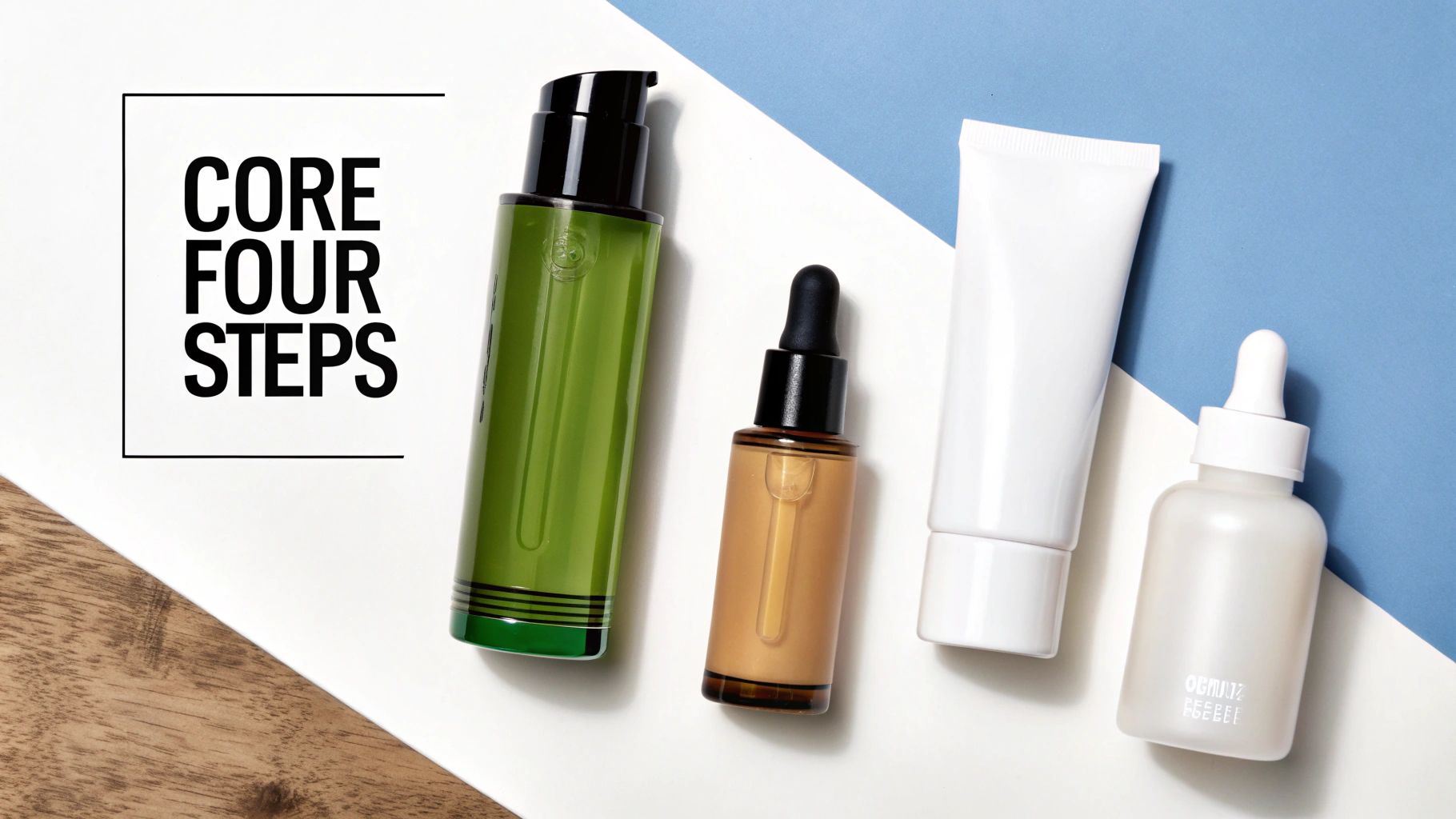
Forget the complicated 12-step routines you see all over social media. The real secret to a skincare routine that actually works is consistency, and that starts with a solid foundation. I call it the Core Four: Cleanse, Treat, Moisturise, and Protect.
These four pillars are the absolute bedrock of skin health. They form a daily ritual that shields your skin by day and helps it repair by night. Getting this foundation right is genuinely everything. It's why facial care is the heart of the beauty world, making up over 34.83% of the UK's massive £17.8 billion beauty market in 2022. It's clear these daily moments of self-care have become central to so many of us.
Your Morning Armour: The AM Protection Routine
Think of your morning routine as one simple mission: to protect your skin from everything the day is about to throw at it. We’re talking UV rays, pollution, and all the other environmental stressors that can speed up the ageing process. The goal is to create a resilient barrier that keeps your skin hydrated, calm, and defended.
It’s like putting on your armour before heading out. Each step builds on the last, creating a shield that keeps the good stuff in and the bad stuff out.
Here’s what that looks like in practice:
A Gentle Cleanse: You don't need a deep scrub in the morning. A simple splash of lukewarm water or a super-mild, creamy cleanser is perfect. You're just whisking away sweat and leftover night products to create a fresh canvas.
Antioxidant Serum: Now’s the time to bring in your protective powerhouse. A Vitamin C serum is the classic morning choice for a reason – it helps neutralise environmental damage and gives your skin a beautiful, bright glow.
Lightweight Moisturiser: Next up, lock in hydration with a moisturiser. This keeps your skin’s barrier happy and prevents moisture from escaping throughout the day, leaving your skin plump and comfortable.
The Non-Negotiable SPF: This is the most crucial step of all. Every single day, rain or shine, you need a broad-spectrum sunscreen of at least SPF 30. It’s your number one defence against premature ageing. No exceptions!
Your Evening Wind-Down: The PM Repair Ritual
Once the day is done, your skin’s job switches from protection to repair. Your evening routine is your chance to properly wash away the day’s grime and give your skin the nourishing ingredients it needs to regenerate while you sleep. This is when your skin is most receptive to those game-changing active ingredients.
It's also a beautiful way to unwind and signal to your mind and body that it's time to rest.
Here's how to make the most of it:
The Double Cleanse: This is a must, especially if you wear makeup or SPF. The first cleanse with an oil or balm melts everything away. The second, with a water-based cleanser, actually cleans your skin. If you want to perfect this, we have some great tips on how to cleanse your face properly for radiant skin.
The Treatment Step: This is where the magic happens. Apply your 'workhorse' serums with ingredients like retinoids, exfoliating acids (think AHAs/BHAs), or peptides to tackle your specific concerns, whether it's fine lines, uneven texture, or breakouts.
A Nourishing Moisturiser: Finish with a richer moisturiser to support your skin's recovery process, lock in your treatment serum, and provide deep hydration while you get your beauty sleep.
At its heart, the difference between your morning and evening routines is simple: AM is for protection, and PM is for correction. Seeing them side-by-side can help clarify their distinct roles.
Your Foundational AM vs PM Skincare Routine
Step | Morning (AM) Routine Purpose | Evening (PM) Routine Purpose |
|---|---|---|
Cleanse | Gently refresh the skin and create a clean base for products. | Remove makeup, SPF, dirt, and pollution from the day. |
Treat | Protect against environmental damage with antioxidants (e.g., Vitamin C). | Repair and regenerate skin with active ingredients (e.g., Retinoids, Acids). |
Moisturise | Hydrate and create a protective barrier for the day ahead. | Deeply nourish and support the skin's overnight renewal process. |
Protect | Shield skin from UV damage with a broad-spectrum SPF. | Not needed – skin is in repair mode, away from the sun. |
This simple framework is your key to consistency and, ultimately, to seeing the results you’ve been hoping for.
The Art of Layering: From Thinnest to Thickest
The order you apply your products in really does matter. A lot. Getting it right ensures each product can actually get into your skin and do its job without being blocked by a heavier one.
My Go-To Rule: Think of it like getting dressed in winter. You wouldn't put your t-shirt on over your coat, would you? The same logic applies to skincare. Always go from the lightest, most watery texture to the thickest, creamiest one.
A watery serum simply can't penetrate through a thick, heavy cream. Applying them in the right order gives each one a fighting chance.
A Simple Layering Guide:
Water-Based Cleanser: Always start with a clean slate.
Toner/Essence: These watery liquids are your prep step.
Serums: Lightweight and potent, these need to go on right after cleansing.
Eye Cream: Gently tap this on around the orbital bone.
Moisturiser: A thicker cream that locks everything in place.
Face Oil (PM) or SPF (AM): This is always your final, protective seal.
By mastering these core AM and PM steps and the simple logic of layering, you’re not just following a routine. You’re creating a powerful, personalised ritual for healthy, glowing skin that will last a lifetime.
Learning to Speak Your Skin's Language
Before you spend a single pound on another product, let’s just pause and listen for a moment. The most effective skincare routine isn't discovered in a bottle; it's found when you learn to understand what your skin is trying to tell you. Think of your skin as having its own unique language, communicating through its texture, how it feels, and what you see in the mirror.
Your mission is to become a fluent interpreter. Instead of just grabbing a product labelled "for oily skin," you'll start to recognise the nuances. Is it genuine oiliness, or is your skin actually dehydrated and overproducing oil to compensate? Learning this language is the first real step toward building a skincare routine that feels intuitive and actually works.
An Easy At-Home Skin Type Test
Let's get rid of the guesswork. This simple method will give you a clear baseline reading of what your skin is doing all by itself. This isn't about finding a rigid label to stick on your forehead, but about getting a snapshot of your skin's natural tendencies right now.
Come clean: Wash your face with a gentle, no-frills cleanser. Pat it completely dry with a soft towel, and then... just wait.
Wait for one hour: This is the most important part. Don't apply anything—no toners, serums, or moisturisers. Let your skin reset to its natural state.
Observe and feel: After that hour is up, get close to the mirror. Look carefully and pay attention to how your skin feels to the touch.
That waiting period gives your skin a chance to show you what it's really like without any products getting in the way. What you see and feel will point you in the right direction.
Your skin is a dynamic, living organ. It changes with the seasons, with stress, and with hormonal shifts. The goal isn't to force it into a box, but to learn how to adapt your care to whatever it needs on any given day.
Interpreting the Results
So, what did you find out? Your observations after that hour are the first real clues to understanding your skin’s default setting.
Oily Skin: Does your face look shiny all over, especially across your forehead, nose, and chin? If the answer is yes, your sebaceous glands are naturally quite active.
Dry Skin: Is your skin feeling tight, taut, or even a little bit itchy? You might notice some flaky patches or just a general lack of glow.
Combination Skin: Is your T-zone (forehead, nose, and chin) looking a bit greasy while your cheeks feel normal or even dry? This is one of the most common skin types out there.
Balanced Skin: Does your skin just feel comfortable? Is it smooth, even-toned, and not too oily or too dry? Congratulations, that's what we call balanced.
This is your starting point. Knowing your general skin type is a massive help in narrowing down product textures. For instance, it tells you to lean towards lighter gels for oily skin and richer, comforting creams for dry skin.
Decoding Your Skin’s Deeper Signals
Beyond your basic type, you have your skin's specific concerns. These are the little (or big) signals it sends when it needs something extra. Learning to spot them is how you graduate from a generic routine to one that is truly your own.
Think of it like this: your skin type is the climate you live in, but your concerns are the daily weather report. You need to be prepared for both.
Common Skin Concerns and What They're Telling You:
Dehydration: Your skin feels tight and looks dull, and fine lines seem more obvious, even if your skin is oily. This is a cry for water, not oil. You need ingredients like Hyaluronic Acid.
Congestion: You're noticing small bumps under the skin, blackheads, and a generally rough texture. This often points to a need for a better cleanse and some gentle exfoliation from ingredients like Salicylic Acid.
Hyperpigmentation: Dark spots or patches are showing up after a breakout or some time in the sun. This means your skin is overproducing melanin and could use ingredients like Vitamin C or retinoids to help even things out.
Sensitivity and Redness: Your skin flushes easily, feels itchy, or reacts to new products with alarming speed. This is a sign your protective barrier is compromised and needs calming, supportive ingredients. For a deeper dive, learning how to calm irritated skin with practical steps is a great next move.
By pairing your basic skin type with an understanding of these specific signals, you stop guessing and start strategising. You’re no longer just chasing trends; you're responding directly to your skin’s needs. This is how you build a real partnership that will lead to your healthiest, most radiant complexion yet.
Introducing Active Ingredients Without the Drama
You’ve got your core four routine down, and your skin is feeling happy and balanced. Brilliant. Now, let’s talk about taking things to the next level. This is where active ingredients—the real powerhouses like retinoids, vitamin C, and exfoliating acids—step onto the scene.
Think of them as specialists you bring in to target your specific concerns, whether that's fine lines, a bit of dullness, or those stubborn breakouts that just won't quit. I know introducing these potent formulas can feel a bit intimidating, but it absolutely doesn't have to be a dramatic, skin-irritating saga. The secret is simply a smart, patient approach. It’s all about working with your skin, not against it.
Getting to Know the Power Players
Before you dash out and add a new serum to your basket, it’s so important to know what you’re actually working with. Each active ingredient has a very specific job, and understanding them helps you choose the right tool for your unique skin goals.
Here’s a quick rundown of the most popular actives I recommend to my clients:
Vitamin C (L-Ascorbic Acid): This is your morning superstar, no question. It's a powerful antioxidant that shields your skin from daily environmental damage, brightens your whole complexion, and helps fade pigmentation. Think of it as your daily defence for a truly radiant glow.
Retinoids (Retinol, Retinal): These are the gold standard for graceful ageing and achieving clear skin. Retinoids work by accelerating skin cell turnover, which is just a fancy way of saying they help soften fine lines, unclog pores, and dramatically improve skin texture. These are strictly for your nighttime routine.
Alpha Hydroxy Acids (AHAs): Ingredients like Glycolic Acid and Lactic Acid work on the skin's surface. They dissolve the 'glue' that holds on to old, dead skin cells, revealing the much smoother, brighter skin hiding underneath. They're fantastic for tackling dullness and uneven texture.
Beta Hydroxy Acid (BHA): Salicylic Acid is the only BHA used in skincare, and it's a game-changer. Unlike AHAs, it's oil-soluble, meaning it can get right down inside your pores to clear out congestion and blackheads. This makes it an absolute hero for anyone with oily or breakout-prone skin.
The ‘Low and Slow’ Method is Your Best Friend
If you remember one thing from this guide, let it be this: the golden rule for introducing any active is to start low and slow. Your skin needs time to get used to these powerful new signals. Trust me, jumping in with a high-strength product every single day is a one-way ticket to irritation, redness, and a damaged skin barrier we'll have to work hard to fix.
Instead, let’s follow this simple, drama-free roadmap:
Patch Test First: I can't stress this enough. Always, always apply a tiny amount of the new product to a discreet area, like behind your ear or on your inner arm. Wait 24-48 hours to see if any irritation pops up. This one simple step can save you from a full-face flare-up.
Choose a Low Concentration: Start with the lowest available strength of the active ingredient. You can always move up to a higher percentage later once you know your skin has fully acclimatised.
Introduce One at a Time: Please don't start two new actives at the same time. If you have a reaction, you’ll have no idea which product is the culprit. Give each new active at least four weeks to settle in before you even think about adding another one.
Think of it like starting a new fitness plan. You wouldn't try to run a marathon on day one, would you? You’d start with a gentle jog, listen to your body, and gradually build up your endurance. The same patient, respectful approach works wonders for your skin.
Creating a Smart Schedule
Once you’ve patch-tested and you’re ready to go, the key is to not start using it daily. You need to ease it into your routine on a carefully planned schedule. This gives your skin essential 'rest days' to recover and adapt, which is fundamental for preventing irritation.
Here’s what that looks like in practice. Let's use retinol as an example:
Weeks 1 & 2: Apply your retinol just twice a week. Make sure it's on non-consecutive nights, like a Monday and a Thursday.
Weeks 3 & 4: If your skin is feeling good, increase this to three times a week—say, Monday, Wednesday, and Friday.
Week 5 and beyond: From here, you can continue to slowly increase the frequency as your skin tolerates it. Honestly, many people find that using a retinol every other night is the perfect sweet spot for incredible results without any of the drama.
Crucial Pairing Rules to Remember
Understanding which ingredients play nicely together is essential for a happy, effective skincare routine. Some actives are best friends; others need to be kept separate to avoid causing chaos for your skin barrier.
AM Hero vs. PM Hero: The simplest rule is to give your main actives their own time to shine. Use your Vitamin C serum in the morning for its protective antioxidant benefits, and save your retinoid or exfoliating acid for the night when your skin is in its natural repair mode.
Don't Mix Retinoids and Exfoliating Acids: On the nights you use your retinol, skip the strong AHA/BHA exfoliant. This is especially true when you're just starting out. The combination can be far too much for the skin, leading to over-exfoliation and a compromised barrier.
Hydration is Non-Negotiable: When you're using powerful actives like retinol, supportive ingredients aren't just a nice-to-have; they're essential. Hyaluronic acid is a fantastic hydrator that can be layered with almost any active to help keep your skin plump, comfortable, and hydrated. We dive deeper into this in our article on Hyaluronic Acid vs. Retinol.
By following these practical, real-world steps, you can confidently bring the most effective ingredients into your routine, unlocking their full potential and getting one step closer to your healthiest skin ever.
Real-World Routines for Your Skin's Journey
Knowing your ingredients is one thing, but seeing how they all fit together in a daily routine is where the real transformation begins. It's the difference between having a list of groceries and creating a delicious meal. So, let's put theory into practice with some real-world examples that you can adapt for your own skincare journey.
Think of these as flexible blueprints, not strict rules. They’re here to inspire you and show you how the core principles of cleansing, treating, and protecting can be combined to achieve a specific goal. Your skin is unique, so listen to it and adjust as you go.
Graceful Ageing and Radiance (30s–50s)
In our 30s, 40s, and 50s, the goal isn’t about reversing time—it’s about looking and feeling our best right now. This routine is all about supporting healthy skin, boosting collagen, softening fine lines, and maintaining that beautiful, even-toned glow.
Your Morning Mission: Protection and Brightness
Cleanse: Start your day with a gentle, hydrating cream cleanser. The aim is to refresh your skin without stripping away its natural, protective oils.
Treat: Now for your hero product: a Vitamin C serum. Think of it as your daily shield against environmental damage that can lead to premature ageing, while also giving your complexion a serious boost of brightness.
Hydrate & Protect: Finish with a quality moisturiser that includes SPF 50. A two-in-one product is a brilliant time-saver and ensures you never skip the single most important step in any anti-ageing routine.
Your Evening Mission: Repair and Renewal
Double Cleanse: Start with a cleansing balm or oil to effortlessly melt away makeup, dirt, and SPF. Follow it up with your gentle morning cleanser to make sure your skin is perfectly prepped for what comes next.
Treat: This is where you’ll alternate your powerful active ingredients to give your skin time to recover and respond. * Night 1 (Retinoid): Apply a pea-sized amount of a gentle Retinol serum. It’s the gold standard for encouraging cell turnover, which helps improve texture and soften lines over time. * Night 2 (Hydration): Give your skin a night off from strong actives. Use a nourishing Peptide or Hyaluronic Acid serum to support your skin barrier and deeply hydrate.
Moisturise: Lock everything in with a rich, restorative night cream. Look for ingredients like ceramides or shea butter to deeply nourish your skin while you sleep.
Tackling Adult Acne and Breakouts
Dealing with adult acne can be so frustrating. It’s often tied to a mix of hormones, stress, and inflammation, which means a gentle, consistent approach is far more effective than an aggressive one. The goal is to find balance.
Your Morning Mission: Calm and Control
Cleanse: A Salicylic Acid cleanser (2%) is fantastic for this. As a BHA, it can get right inside the pores to gently exfoliate and clear out congestion before it turns into a breakout.
Treat: Follow up with a Niacinamide serum. This is a true multi-tasker; it helps regulate oil production, calms down inflammation and redness, and helps strengthen your skin’s barrier.
Hydrate & Protect: Always use a lightweight, oil-free moisturiser and a non-comedogenic SPF 50. Sunscreen is non-negotiable, as it helps prevent those stubborn dark marks (post-inflammatory hyperpigmentation) that spots can leave behind.
Your Evening Mission: Decongest and Soothe
Double Cleanse: An evening double cleanse is crucial for acne-prone skin. Start with a lightweight cleansing oil and follow with your salicylic acid cleanser.
Treat: Alternate your treatments to keep skin clear without causing irritation. * 3 nights/week: Use a gentle Retinoid. It’s incredibly effective for acne because it helps normalise skin cell turnover, preventing pores from becoming clogged in the first place. * Other nights: Focus on targeted care. Apply a spot treatment with succinic acid or benzoyl peroxide directly onto any active breakouts.
Moisturise: Finish with a simple gel-cream moisturiser. You want something that provides hydration without feeling heavy or greasy.
A Quick Reminder: When you're bringing a new active ingredient into your routine, patience is everything. Trying to do too much, too soon is the fastest way to irritate your skin and undo all your hard work. A slow, steady introduction always wins the race.
This visual guide breaks down the simple, essential steps for welcoming a new active into your skincare family.
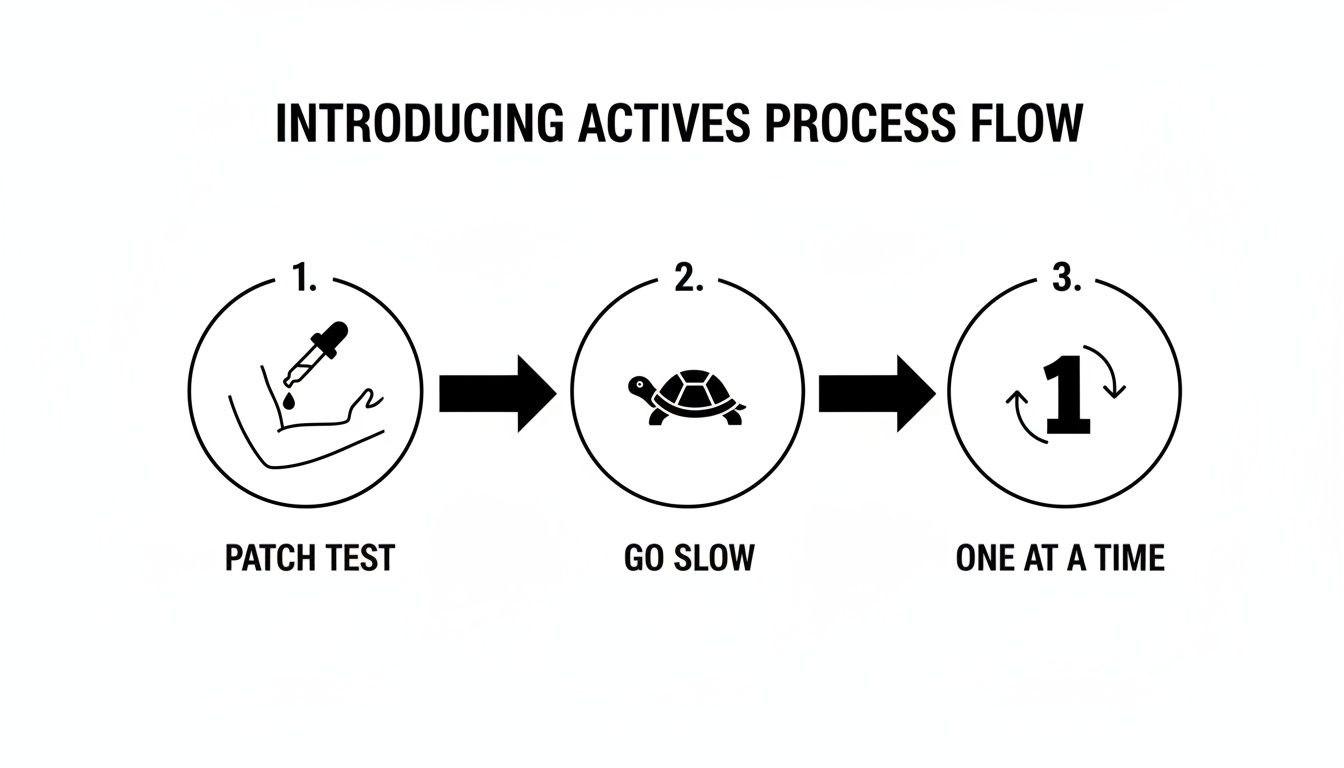
The key is to respect your skin’s adjustment period. Always patch test, start with a low frequency, and only introduce one new powerful product at a time.
Calming Sensitive and Reactive Skin
If your skin easily gets red, itchy, or irritated, your routine needs to be its safe space. Here, the focus is all about strengthening your skin's protective barrier and using calming, anti-inflammatory ingredients. Less is definitely more.
Your Morning and Evening Routine: Soothe and Strengthen
For truly sensitive skin, keeping your morning and evening routines almost identical can work wonders. The only change is adding SPF in the morning.
Cleanse: Your best friend is a milky, non-foaming cleanser. Look for comforting formulas with ingredients like oat or centella asiatica.
Treat: Choose a serum focused purely on barrier repair. Niacinamide is a great choice, as are serums containing Ceramides. If you struggle with redness, Azelaic Acid can be wonderfully calming.
Moisturise: A rich, comforting cream is what you need. It should feel like a protective hug for your skin.
Protect (AM Only): Opt for a Mineral Sunscreen (SPF 50). Formulas with zinc oxide or titanium dioxide are often much better tolerated by sensitive skin than their chemical counterparts.
Here's a quick-glance table to help you visualise how these routines come together.
Sample Routines by Skin Concern
Skin Concern | Sample AM Routine | Sample PM Routine |
|---|---|---|
Ageing (30s–50s) | 1. Gentle Cream Cleanser2. Vitamin C Serum3. Moisturiser with SPF 50 | 1. Double Cleanse (Balm + Cream)2. Alternate: Retinol or Hydrating Serum3. Rich Night Cream |
Adult Acne | 1. Salicylic Acid Cleanser2. Niacinamide Serum3. Oil-Free Moisturiser + SPF 50 | 1. Double Cleanse (Oil + Salicylic)2. Alternate: Retinoid or Spot Treatment3. Lightweight Moisturiser |
Sensitivity | 1. Milky Cleanser2. Barrier Serum (Niacinamide/Ceramides)3. Soothing Cream4. Mineral SPF 50 | 1. Milky Cleanser2. Barrier Serum (Niacinamide/Ceramides)3. Soothing Cream |
These examples should give you a solid foundation for building a routine that truly works for you. Use them as your guide, pay attention to how your skin responds, and enjoy creating a daily ritual that makes you feel amazing.
Common Questions and Expert Answers
Starting a new skincare routine is exciting, but it’s completely normal to have a few questions along the way. Think of this as your go-to guide for those "is this normal?" moments. We'll talk about realistic timelines, nail down the simple rules for applying products, and cover how to use powerful ingredients without upsetting your skin.
This is all about giving you the clarity and confidence to trust the process and really enjoy the journey to healthier, happier skin.
How Long Until I Actually See Results?
This is, without a doubt, the question I hear most often. The honest answer? It’s a lesson in patience and consistency. While your skin might feel softer and more hydrated almost right away, tackling concerns like texture, breakouts, or pigmentation takes a bit more time.
Your skin has a natural rhythm of its own. It’s constantly renewing itself by shedding old cells and bringing fresh ones to the surface. This cycle takes about 28 days (and slows down a little as we get older). For any new product to truly make a difference, you need to give it at least one full cycle, but I always recommend giving it two.
My Practical Advice: Commit to a new routine or a new active ingredient for at least 4 to 6 weeks before you make a call on whether it's working. Taking a quick photo once a week can be a brilliant motivator—it helps you see those subtle improvements that you might miss just looking in the mirror every day.
What’s the Right Order to Apply My Products?
We've touched on this before, but it’s a rule worth repeating because it makes a huge difference in how well your products perform. The simplest, most reliable principle is to layer your products from the thinnest to the thickest consistency.
Think of it like this: you wouldn't be able to get a glass of water to soak through a thick winter coat, would you? It's the same idea with skincare. A light, watery serum just can't penetrate a rich, heavy cream.
Here’s a simple order to remember:
Cleanser: You always need to start with a clean canvas.
Toners/Essences: These watery, liquid steps come first.
Serums: Lightweight and packed with actives, they need to get to the skin first to do their job properly.
Moisturiser: This is your thicker, hydrating layer that locks in everything underneath.
SPF (in the morning) / Face Oil (at night): This is your final, protective seal.
Following this sequence makes sure every product can actually be absorbed without being blocked by something heavier. It’s the key to getting the maximum benefit from every single step.
Can I Use Too Many Actives at Once?
Oh, absolutely. This is one of the most common mistakes I see people make. In the rush to fix skin concerns, it’s so tempting to throw everything at it at once—retinoids, vitamin C, exfoliating acids, you name it.
But this approach usually backfires. It often leads to a compromised skin barrier, which means redness, irritation, and sensitivity—the very things you're trying to avoid! Your skin barrier is your first line of defence, and keeping it strong and healthy is the most important job of all.
The best way forward is to introduce powerful ingredients slowly, one at a time. This gives your skin a chance to adapt and helps you figure out which products are actually delivering results and which ones might be causing trouble. A strong, healthy barrier is the foundation of any great skincare routine.
Navigating the world of skincare is a personal journey, and having expert guidance can make all the difference. At YOUTHFUL REVIVAL, we specialise in creating personalised treatment plans and providing honest advice to help you achieve refreshed, natural-looking results. Whether you're considering in-clinic treatments or exploring our clinic-formulated Nunya skincare range, we're here to support you. Book a consultation with us today and take the next step towards the skin you've always wanted.
Comments