
Discover what causes forehead wrinkles: Causes, prevention, and tips

Forehead wrinkles aren’t the result of a single cause. Think of them more like a story written on your skin, a unique map shaped by your biology, your expressions, and the life you live. It's the blend of expressive movements, the natural dip in skin-firming proteins like collagen, and daily environmental exposure that truly sets those lines in place. Understanding this is your first step towards taking control.
The Real Reasons You Have Forehead Wrinkles
Ever catch yourself in the mirror and notice that the lines from a surprised expression now hang around long after your face has relaxed? That's a completely normal part of how your skin matures. It's the moment when dynamic lines (the ones you see with movement) begin to transition into static ones (the ones that are always there)—a journey we all experience.
Imagine your skin is like a fresh piece of paper. You can fold it once or twice, and it springs right back. But if you keep folding it along the very same line, time and time again, a permanent crease will eventually form. Your facial expressions work in exactly the same way.
From Fleeting Expressions to Fixed Lines
Every single time you raise your eyebrows, furrow your brow in thought, or squint at a bright screen, you’re contracting your frontalis muscle. This powerful muscle pulls the skin up, creating temporary folds we call dynamic wrinkles. When you're younger, your skin is rich in collagen and elastin—the essential proteins that give it that beautiful bounce and firmness. Thanks to them, your skin smooths out instantly.
But as the years go by, the story changes.
"The constant repetition of facial movements, combined with a natural loss of skin elasticity over time, is the fundamental reason dynamic lines eventually become static. They are the echoes of a lifetime of your unique expressions."
This shift is the key to understanding why forehead wrinkles become a lasting feature. Your skin's inner scaffolding gradually weakens, losing its incredible ability to snap back into place.
The main culprits behind this change are:
Ageing and Collagen Loss: Once you hit your late 20s, your body starts producing about 1% less collagen in the skin per year. This slow and steady decline is what reduces your skin's natural plumpness and resilience.
Sun Exposure: Nothing accelerates the breakdown of collagen and elastin quite like UV radiation. This is the number one external factor that you have control over to prevent lines from forming too quickly.
Lifestyle Habits: Things like smoking, not drinking enough water, and even high levels of stress can all get in the way of your skin's ability to repair itself, making lines look deeper than they need to be.
Truly understanding these core reasons is the first empowering step toward reclaiming a smoother, more revitalised look. It’s never about erasing your story, but about feeling confident enough to write the next chapter.
To make it even clearer, let's break down these factors.
Forehead Wrinkle Causes At a Glance
Here’s a quick summary of the main internal and external forces that contribute to the lines on your forehead. This helps you see where you can make the biggest impact.
Cause Category | Primary Factor | How It Contributes |
|---|---|---|
Internal Factors | Intrinsic Ageing | Collagen and elastin production naturally decline from our late 20s, reducing skin's elasticity and firmness. |
Internal Factors | Repetitive Muscle Use | Repeatedly contracting the frontalis muscle (e.g., raising eyebrows) creates folds that become permanent over time. |
External Factors | Sun Exposure (UV Rays) | Accelerates the breakdown of collagen and elastin, leading to premature ageing and deeper wrinkles. |
External Factors | Lifestyle & Environment | Dehydration, smoking, and stress can impair skin repair, making lines appear more prominent. |
Seeing it laid out like this helps to show how it's not just one thing, but a combination of factors that shapes how your skin evolves.
How The Sun Quietly Carves Lines Into Your Forehead
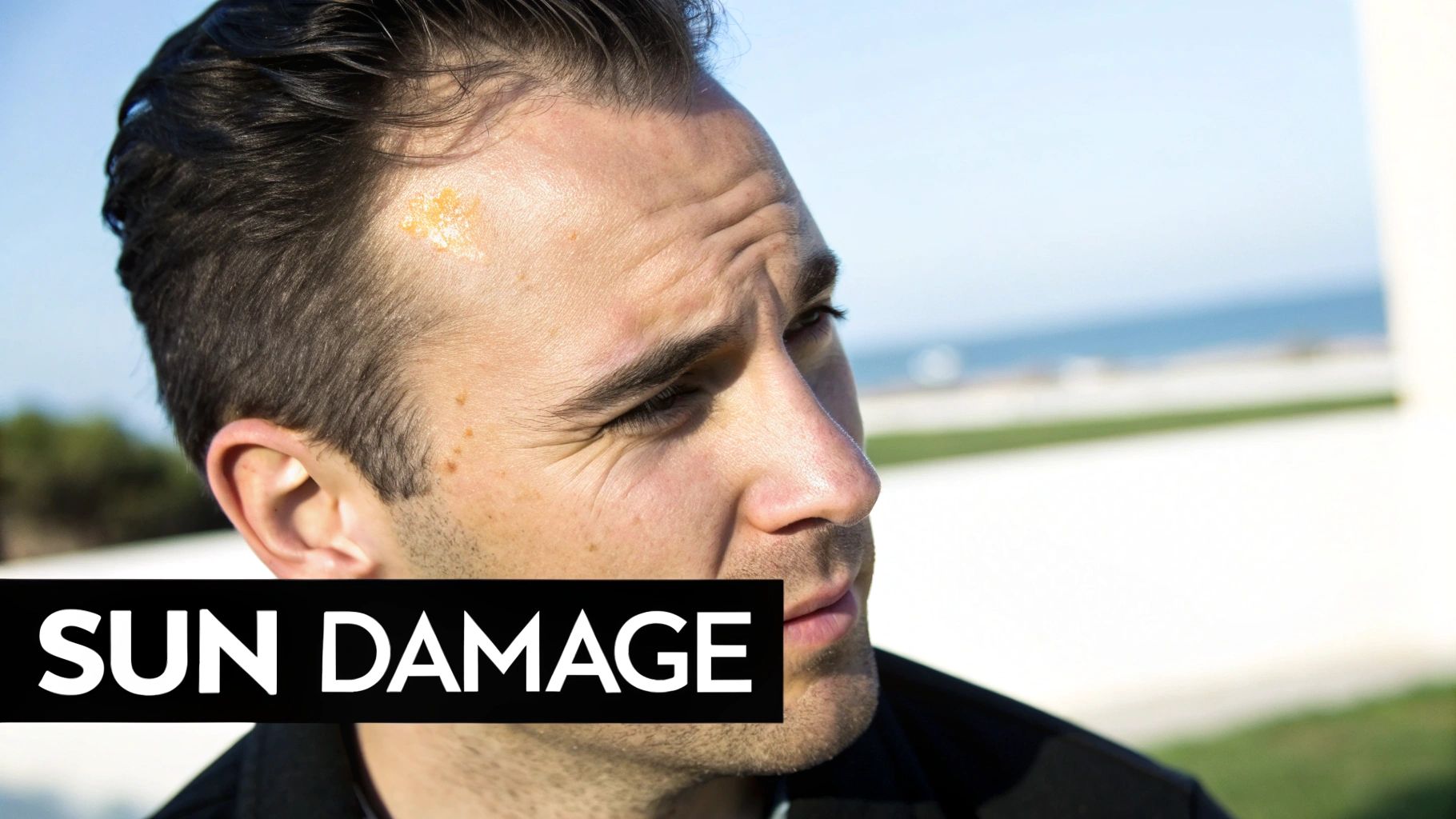
When we talk about forehead lines, one culprit stands head and shoulders above the rest. It’s the single biggest accelerator of skin ageing that you have direct control over. It works its magic silently, day after day, even on those quintessentially British cloudy afternoons. I’m talking about sun exposure, and its effect on your skin is nothing short of profound.
Think of a brand-new elastic band. It’s springy, strong, and snaps back into shape instantly. Now, imagine leaving that same band out in the garden all year. It turns brittle, fragile, and eventually breaks with the slightest tug. This is a brilliant picture of what ultraviolet (UV) radiation does to the very foundation of your skin.
UV rays delve deep into the skin, where they start to dismantle collagen and elastin – the twin proteins that give your skin its firmness, plumpness, and bounce. This relentless process, which we call photodamage, is the main reason your skin starts to look older than it should.
The Real Damage Is Done Day by Day
It’s a common misconception that sun damage only happens when you’re sunbathing on holiday. The truth is far more subtle. The cumulative effect of everyday, incidental sun exposure—the walk to the shops, sitting by a window at work, the daily commute—is what secretly etches those lines onto your forehead over a lifetime.
The science on this is crystal clear. Studies have shown that a staggering 80% to 90% of the visible signs of facial ageing, including forehead wrinkles, can be traced directly back to a lifetime of UV exposure. This means the vast majority of lines you see aren't just a side effect of getting older; they're the result of the sun's persistent influence.
Your most powerful weapon against future lines and your best strategy for softening existing ones isn't some expensive, complex secret. It's the simple, consistent habit of protecting your skin from the sun. Every single day. All year round.
This isn’t about hiding from the sun entirely. It’s about being smart and making protection an absolute non-negotiable part of your daily ritual. Think of it as making a daily investment in your future skin, ensuring it stays as smooth and resilient as possible for years to come.
Making Sun Protection an Effortless Habit
The key is to make sun protection so automatic you don't even think about it, just like brushing your teeth. If you can do this one thing, you are already winning the battle against premature wrinkles.
Here are a few practical ways to get started:
Find a Sunscreen You Genuinely Like Using: Gone are the days of thick, chalky pastes. Modern sunscreens are a world away, with lightweight, elegant formulas. Find a broad-spectrum SPF 30 (or higher) that feels lovely on your skin and works well with your other products.
Make It a Two-in-One Step: Many brilliant daily moisturisers now come with high SPF protection built-in, turning two steps into one simple morning application. This is the easiest way to ensure you never forget.
Remember to Top Up: If you’re going to be outside for a long time, especially when the sun is strong, make sure to reapply your sunscreen every couple of hours to keep that protective shield active.
By truly understanding and respecting the sun's power, you put yourself back in the driver's seat. If you're already concerned about the signs of sun damage, our guide to skin sun damage treatment offers practical insights into managing its effects. Making sun protection a priority is one of the greatest acts of self-care you can do for your skin.
Your Skin's Natural Journey Through Time
Let's talk about the beautiful, and completely normal, process of how your skin matures. As the years go by, your body’s internal factory for producing collagen and elastin—the proteins that keep skin firm and bouncy—naturally starts to wind down. This isn't a defect; it’s just part of your human story.
Think of your skin in your youth like a brand-new, luxury mattress. It’s plump, supportive, and snaps right back into place. Over time, those supportive springs—your collagen and elastin fibres—begin to lose some of their tension. It’s a very gradual shift.
This means the surface doesn't have quite the same tautness it once did. Those lines that used to appear when you raised your eyebrows, only to disappear moments later, now start to stick around a little longer.
Why Skin Loses Its Bounce
The main reason for this change is a natural decline in these crucial structural proteins. In fact, from your late 20s onwards, your skin produces about 1% less collagen every single year. That might not sound like a lot, but over a decade, its effects really add up, slowly reducing the skin’s density and fullness.
This loss of structural integrity is precisely what causes forehead wrinkles to become more etched in over time. The skin itself becomes thinner and has less ability to resist the constant pull of the muscles moving underneath.
Understanding this natural journey is the first step toward working with your skin, not against it. It's about empowering yourself with the knowledge to give your skin the exact support it needs to feel firm and look radiant at every age.
While this internal ageing process happens to everyone, the timeline is entirely your own. Genetics certainly play a part, but as we've discussed, external factors can either help protect your collagen or speed up its decline.
For instance, research focusing on the UK population confirms that a loss of skin elasticity is a well-established cause of forehead wrinkles. Studies show a strong link between advancing age and how pronounced wrinkles become, especially after 35, with a noticeable increase beyond 40.
The Key Takeaways
Your skin’s evolution is a map of your life’s journey. Here's a simple summary of what's happening just beneath the surface:
Collagen Slowdown: Your body's production of this essential firming protein naturally eases off with age.
Elastin Weakening: The fibres that give skin its 'snap-back' quality lose some of their resilience.
Thinner Skin: With less of a supportive cushion, the skin is more likely to crease from facial movements.
When you see this not as a battle to be won, but as a natural process to be supported, it changes your entire perspective. It shifts the focus from anxiety to action, helping you make positive, informed choices for your skin's long-term health and vitality.
The Daily Habits That Deepen Forehead Lines
Your skin is a living diary, and your forehead often tells the most vivid stories. It doesn't exist in a vacuum; it’s a direct reflection of your daily life, your unconscious expressions, and your deepest-held habits. Understanding this connection is the first, most powerful step towards taking back control and smoothing out the narrative.
Think about it. How many times a day do you furrow your brow when you’re deep in thought, or raise your eyebrows in surprise during a conversation? Each of those movements is like folding a piece of paper along the same crease. Do it once, and the paper springs back. Do it a thousand times, and the line becomes a permanent feature. That’s exactly what’s happening with your skin.
The Impact of Lifestyle on Your Skin's Resilience
But it’s not just about expression. The choices you make every day have a profound effect on your skin’s ability to bounce back. Things like smoking, a diet that’s low on skin-loving nutrients, or even chronic stress can quietly sabotage its natural repair processes, making those lines appear deeper and more pronounced.
This isn’t about blame; it’s about awareness. Every single choice you make is an opportunity to either support your skin’s health or hinder it.
"Your daily rituals hold immense power. By making small, mindful shifts in your habits, you can actively protect your skin from preventable ageing and preserve its natural vitality."
Take stress, for example. When you’re constantly under pressure, your body releases cortisol, a hormone that’s notorious for breaking down the collagen and elastin that keep your skin firm and plump. That internal tension shows up on the outside, weakening your skin's very foundation and leaving it vulnerable to wrinkles.
Small Swaps for a Smoother Future
The truly wonderful news is that this story isn't set in stone. You have the power to change the narrative. By making simple, positive tweaks to your daily routine, you can make a huge difference to your skin’s health and begin to soften those forehead lines.
Mindful Expressions: Start paying attention to your "facial posture." When you’re concentrating or feeling stressed, consciously relax your forehead. A few deep, calming breaths can make an incredible difference.
Nourish from Within: Think of your plate as your first line of defence. Pack it with antioxidant-rich foods like berries, leafy greens, and vibrant vegetables that help fight the environmental damage that speeds up ageing.
Prioritise Rest: Never underestimate the power of a good night's sleep. Aiming for 7-9 hours allows your skin to enter its peak repair mode, rebuilding and rejuvenating while you dream.
In the UK, lifestyle factors like smoking and repeated facial movements are massive contributors to forehead wrinkles. The link is so clear, in fact, that over 900,000 Botox injections are carried out every year to address these very expression lines. That number alone shows just how many people are looking for a real solution. You can discover more about the impact of lifestyle on dynamic wrinkles.
By embracing these small but meaningful changes, you're doing so much more than just preventing future lines. You're making a daily investment in a more radiant, resilient, and confident you.
Your Action Plan For Smoother Skin
Knowing what causes those lines on your forehead is one thing, but now it's time to put that knowledge into action. Think of this as your personal playbook for creating a smoother, more radiant future for your skin. It’s all about weaving powerful daily habits together with the best of professional skincare to get results you can see and feel.
Let's start with the absolute essentials of any great routine. These are the non-negotiables, your first line of defence against lines setting in for good.
Start With Your Skincare Fundamentals
Picture your daily skincare as the foundation of a house. Without that solid base, even the most impressive-looking structure won't stand strong. The same is true for your skin; advanced treatments can’t deliver their full magic without the right groundwork.
The single most important step is one we’ve already mentioned: daily, year-round sun protection. A broad-spectrum sunscreen with at least SPF 30 is your skin’s best friend. It’s a constant shield against the UV damage that chips away at your precious collagen.
Beyond that, a few key ingredients are true game-changers. Retinoids, which are powerful derivatives of Vitamin A, are famous for their ability to speed up cell turnover and kickstart collagen production. They get to work gradually, smoothing the skin's surface and softening the look of fine lines over time. Think of it as training your skin to behave more youthfully.
This flowchart really brings home how much our daily habits influence our skin's health.
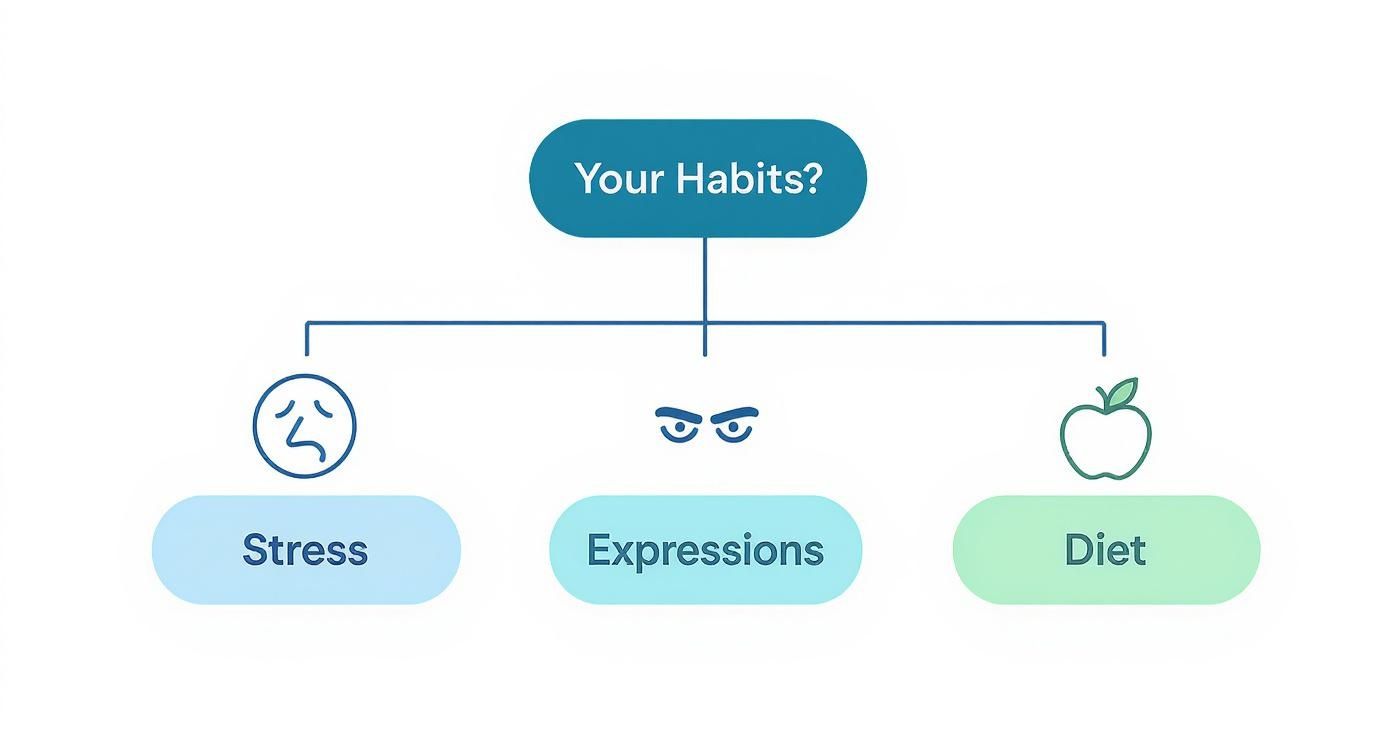
It’s a simple reminder that the choices you make around stress, diet, and even your unconscious facial expressions all tell a story on your skin.
Explore Professional Treatment Options
When you’re ready for a more noticeable shift, or if your lines are sticking around even when your face is perfectly still, professional treatments can offer truly remarkable results. It’s never about changing who you are—it’s about refreshing your appearance and helping you feel as vibrant on the outside as you do on the inside.
Let's break down the most popular and effective options.
Anti-Wrinkle Injections (like Botox): This is the gold standard for tackling dynamic wrinkles—those lines that pop up when you raise your eyebrows or frown. The treatment works by temporarily relaxing the specific forehead muscles that create these creases. The result? A much smoother surface, which also helps prevent those expression lines from becoming permanently etched into your skin.
Dermal Fillers: While anti-wrinkle injections work on the muscles, fillers focus on restoring lost volume. If you have very deep, static lines that have been there for a while, a skilled clinician might use a soft, hyaluronic acid-based filler. It gently lifts the crease from underneath, plumping it out for a softer, more youthful look.
To help you get a clearer picture of what might work for you, we have a detailed guide covering more effective ways to reduce fine lines and achieve smoother skin.
For a quick overview, this table compares the most common professional treatments side-by-side. It lays out how each one works, the type of wrinkle it’s best suited for, and what you can expect in terms of results.
Comparing Treatments for Forehead Wrinkles
Treatment | How It Works | Best For | Results Timeline |
|---|---|---|---|
Anti-Wrinkle Injections | Relaxes the underlying muscles to stop them from creasing the overlying skin. | Dynamic lines that appear with expression. | 3-7 days, lasts 3-4 months. |
Dermal Fillers | Adds volume with hyaluronic acid to plump and lift deep, set-in lines from beneath. | Static wrinkles that are visible when the face is at rest. | Immediate, lasts 6-18 months. |
Ultimately, choosing the right path comes down to understanding your skin and your goals. This action plan puts you firmly in control. By combining consistent, protective skincare at home with precisely targeted professional treatments, you can write a new, smoother chapter for your skin.
When To Seek Expert Advice For Your Skin
Your daily skincare routine is a powerful act of self-care and the bedrock of healthy, vibrant skin. But there are moments when even the most diligent at-home efforts hit a plateau, and that's completely normal. Recognising when it's time to call in an expert isn't a defeat; it's an empowering step on your journey to achieving the skin you truly love.
So, when is the right time to reach out? The signs are usually quite clear. You might notice those lines on your forehead have decided to stick around, even when your face is perfectly still. Or maybe the serums and creams you once swore by just don't seem to be making a difference anymore. This is a clear signal that your skin needs a different approach.
Moving Beyond Your At-Home Routine
Think of this as your skin signalling that it’s ready for the next level of care. A professional consultation isn't something to be daunted by—it's just a warm, honest chat about your skin and your aspirations. It’s your chance to team up with an expert who can map out a plan that’s tailored just for you.
The goal is always to achieve beautifully natural results that make you feel refreshed and confident, not fundamentally changed. It’s about enhancing the best version of yourself.
This partnership approach takes the mystery out of treatments and puts you firmly in the driver's seat. Whether you're curious about options like anti-wrinkle injections to soften those expression lines or other advanced solutions, a proper consultation ensures the path forward is safe, clear, and perfectly in sync with your vision.
At Youthful Revival, we see seeking expert advice as a proactive and positive choice. If you're wondering what's possible, you can learn more about how expertly administered anti-wrinkle injections can smooth forehead lines and help you feel amazing in your own skin. This is your opportunity to feel fully informed and excited about what comes next.
Your Questions About Forehead Wrinkles, Answered
It's completely normal to have questions when you first start looking into ways to smooth your skin. With so much information out there, it can feel a bit overwhelming! We hear a lot of the same queries from our clients, so let's tackle some of the most common ones head-on.
At What Age Do Forehead Wrinkles Usually Start to Appear?
There really is no set age, because everyone's skin tells a different story. Some people might spot the first faint expressive lines in their late 20s, while for others, they don’t really start to stick around until their mid-to-late 30s.
Honestly, the biggest factor isn't the number on your birthday cake. It's a combination of your genetics and how much sun you've seen over the years. Someone with a history of sunbathing could see lines develop much earlier than a person who has always been diligent with their sunscreen. This is why sun protection from an early age is your best long-term strategy.
Can Drinking More Water Get Rid of My Forehead Wrinkles?
While staying properly hydrated is fantastic for your overall skin health and can give it a plumper, more radiant look, water alone won't magically erase deep, set-in wrinkles.
Think of it this way: a dehydrated grape shrivels into a raisin, and giving it water plumps it back up. In the same way, good hydration can definitely soften the look of very fine, surface-level lines. But it can’t rebuild the collagen and elastin fibres that have broken down over time, which is the real reason for deeper wrinkles. For that, you need solutions that work on the skin's underlying structure.
The best strategy is always a combination of looking after yourself from the inside out. Great hydration provides the foundation, and targeted treatments help rebuild the framework.
Do Facial Exercises or 'Face Yoga' Actually Work for Wrinkles?
This is a really popular myth, but the thinking behind it is a little backwards. Forehead wrinkles are caused by muscles working too much, not by them being weak. Purposefully contracting these muscles over and over again through exercises can actually deepen those lines over time.
That's why proven treatments like anti-wrinkle injections are so effective—they work on the complete opposite principle. By gently relaxing the muscles, they smooth out the overlying skin and prevent those expression lines from becoming permanently etched in. It's about letting the muscle rest, not giving it a workout.
Ready to turn your questions into a clear plan of action? Here at Youthful Revival, we believe in creating personalised treatments that deliver beautiful, natural-looking results. Book your consultation today and let's begin your journey towards feeling refreshed and confident in your skin.

Comments